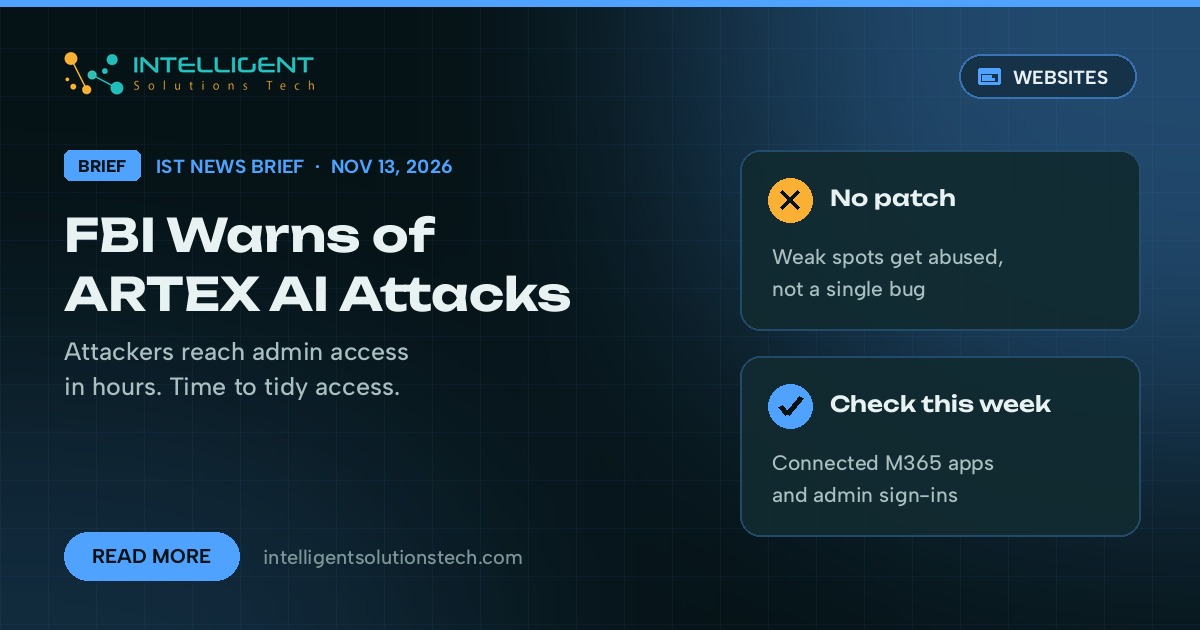
The FBI published a FLASH advisory on November 13, 2026 warning that criminals and state-backed groups are using ARTEX, an AI-driven penetration testing tool, to break into business systems with very little human effort. The advisory is marked TLP:CLEAR, so anyone can share it, and it comes with a defensive checklist that small teams on Microsoft 365 can start on this week.
What’s new
ARTEX is an open-source tool written in Go. It doesn’t ship its own AI model. It plugs into outside language models and turns a plain-language goal into commands that separate agents run, from scanning to stealing data. The FBI said attackers have used it since at least August 2026 and that some intrusions reached privileged access in under three hours.
- The original GitHub project was taken down on October 8, 2026, but the FBI said forks, mirrors and a paid version are still around, with more than 1,600 exposed ARTEX consoles found by early November.
- One campaign went through ConnectWise Cloud Backup and reached more than 2,250 downstream Microsoft 365 tenants, according to the advisory.
- The FBI said the tool works best against systems people forget about: partner portals, old services, mobile app backends and third-party connections.
Who it affects
Any business with apps connected to its Microsoft 365 tenant, a customer or partner login area, or an old admin panel still reachable from the internet. If your IT provider ever connected ConnectWise Cloud Backup to your Microsoft 365 account, the FBI’s ConnectWise steps apply to you directly, even if you stopped using it.
Our take
There’s no patch to install here, so we’d treat it as a housekeeping week. First, open the Enterprise applications list in Microsoft Entra and remove any app you don’t recognize or no longer use, starting with the ones that hold high permissions. Second, ask your IT provider whether ConnectWise Cloud Backup was ever authorized on your tenant and, if so, whether they’ve reviewed sign-ins back to October 1 as the FBI recommends. Admin pages for your website, hosting panel and backups should sit behind two-factor sign-in, and ideally an IP allowlist.
Our IT consulting and website maintenance teams can run that review with you, and our brief on the ScreenConnect MSP attacks covers a similar supplier-side risk. The full advisory, with indicators of compromise, is on the FBI’s IC3 site.