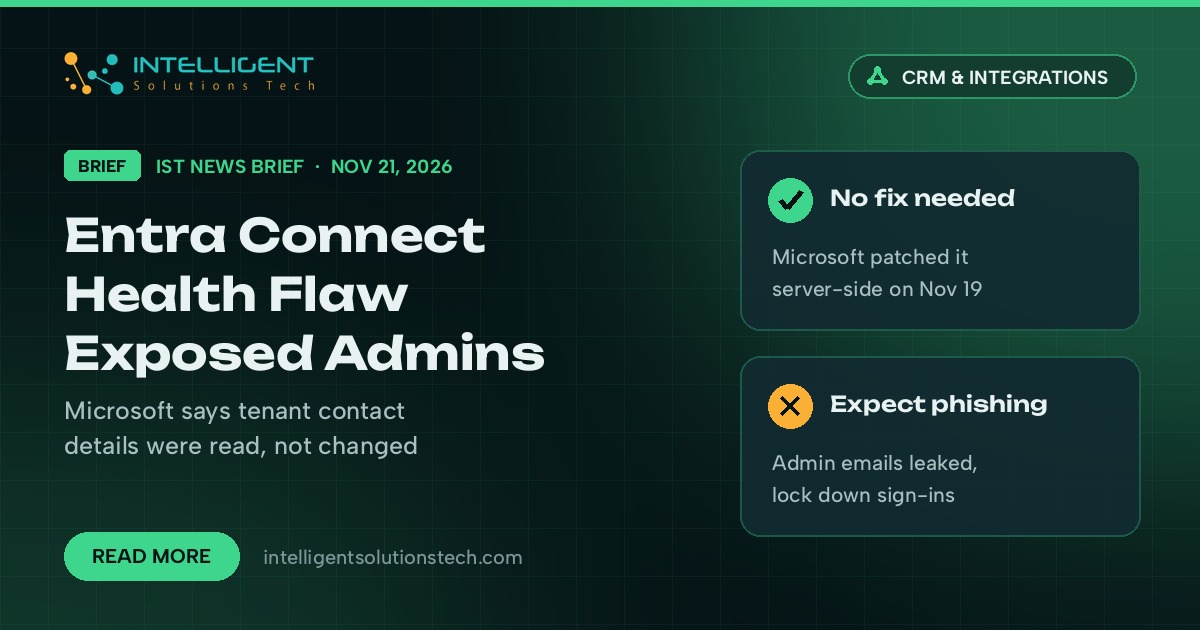
Microsoft has confirmed that attackers exploited a flaw in Microsoft Entra Connect Health to read tenant contact and configuration details. According to a notification Microsoft sent to affected admins on November 20, 2026, reported by BleepingComputer on November 21, the bug was introduced on July 23, found on November 9 and fixed server-side on November 19. Microsoft finished its investigation on November 20 and began notifying affected organizations through Azure Service Health.
What’s new
- Microsoft told affected customers that the access was read-only and that it found no unauthorized configuration changes.
- The exposed details included email addresses of tenant technical contacts and admin accounts, tenant IDs, display names, initial domain names, country and region, Entra license tiers, directory sync status and Connect Health onboarding status.
- Microsoft says no passwords, password hashes, sign-in tokens, valid keys, on-premises Active Directory layout or Azure subscription details were exposed.
- No update or customer fix is required. Microsoft published a PowerShell script at aka.ms/ConnectHealth/scripts that shows which kinds of metadata your tenant holds, though it reads current values, not what was taken.
- Microsoft hasn’t said how many tenants were hit or who was behind it. Admins on Reddit, including managed service providers, reported getting notices for several client tenants.
Who it affects
Connect Health is used by organizations that sync an on-premises Active Directory with Microsoft 365, so plenty of cloud-only small businesses won’t have it switched on. If you do run a hybrid setup, or an IT provider manages your Microsoft 365 tenant, check Azure Service Health or ask your provider whether a notice arrived. Nobody has reported a break-in so far. The practical risk is that attackers now hold a list of real admin email addresses tied to real company tenants, and that’s the raw material for convincing phishing.
Our take
Treat this as a phishing warning with names attached. We’re telling clients to do three things this week. Make sure every admin account uses phishing-resistant sign-in, such as passkeys or the Microsoft Authenticator app with number matching, instead of SMS codes. Warn anyone with admin rights to expect fake “Microsoft security notice” emails and to open the admin center directly instead of clicking links. Then skim the Entra sign-in and audit logs for unfamiliar locations or new admin roles. If Microsoft 365 security has been sitting with nobody in particular, our IT consulting team can take a look, and our Microsoft Ignite 2026 brief covers the other Microsoft 365 changes on the way. We covered a similar provider-side incident this week in our N-able Mail Assure brief.
Primary report: BleepingComputer, Microsoft Entra Connect Health flaw exploited to steal tenant data.
Not sure who’s watching your Microsoft 365 admin accounts? Start with our IT consulting service.