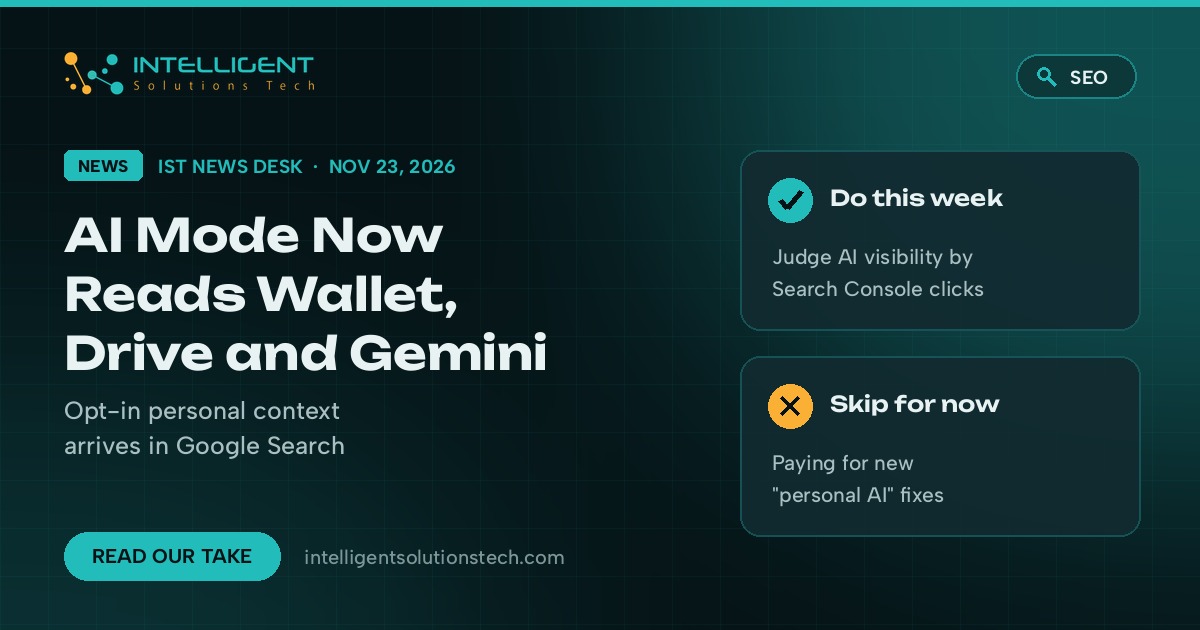
Google is connecting more of a person’s own apps to Search. In a post on the Google blog on November 23, Robby Stein, Google’s VP of Product for Search, said people can now opt in to connect Google Wallet to Personal Intelligence in AI Mode, with Google Drive and the Gemini app following in the coming weeks. Those join Gmail, Calendar and Photos, which could already feed AI Mode answers.
The same post says AI Overviews and AI Mode will start giving more personally relevant responses based on a person’s recent searches, so someone planning a trip can pick up where they left off in a new thread.
Our view is calm but clear. Two people typing the same question will see different AI answers more often, and any report built on one logged-out screenshot gets less useful. We’re telling clients to change how they measure AI visibility this week, and to leave their content plans alone until the new answers settle.
What changed
According to Google’s announcement, the rollout has three parts.
- Google Wallet: starting today, people can connect Wallet to Personal Intelligence in AI Mode and in the Gemini app. Google says AI Mode can only read account information and can’t move, manage or invest money.
- Google Drive: in the coming weeks, AI Mode can use a person’s Docs, Sheets and PDFs to shape answers, such as a preparation plan before tax season.
- The Gemini app: in the coming weeks, context will flow both ways between Gemini chats and AI Mode.
Every app connection is opt-in, managed under Search Personalization, then Connected Apps. Google also said a Personalization icon will soon appear under personalized answers so people can see what context was used. The recent-search personalization in AI Overviews and AI Mode can be adjusted or switched off in Search settings, according to the post. Google didn’t name the countries or account types covered.
What it means for your business
Google’s post doesn’t describe any change to which public pages AI Mode cites. What changes is the question that gets answered. When AI Mode knows someone’s budget, their last three searches and the quote sitting in their Drive, it narrows the answer before your page ever enters the picture. The same query from two customers can now produce two different shortlists.
For a local service business, that can help. A homeowner who has already compared roofers will get a follow-up answer that assumes that context, and pages that answer the next question (cost factors, timelines, warranties, service areas) have more chances to be cited. For a store, Wallet context could shape shopping answers around a person’s budget and the cards they hold.
Measurement is the bigger change. Rank trackers and AI visibility tools mostly run clean, logged-out queries. Real customers increasingly won’t see that version. A tool can tell you whether you show up at all, while Search Console tells you whether real people clicked.
We’d also expect more answers that draw on Gmail. If your booking confirmations, quotes and receipts are vague, a customer asking AI Mode about their appointment may get a vague answer too.
What we’d do this week
- Judge AI visibility by Search Console clicks and impressions for your key pages and queries, compared week over week, and treat single screenshots as anecdotes.
- Keep your third-party AI visibility tool as a presence check. It tells you whether you appear at all; it can’t show what each customer sees.
- Check that service pages answer the follow-up questions buyers ask after their first search: price factors, timelines, service areas, and what happens after they book.
- Rewrite booking confirmation and quote emails so the business name, address, date and next step are in plain text, not only inside an image.
- Hold off on anyone selling “personal AI search” fixes as a new service. Nothing here gives site owners a new setting to change.
Want a second opinion on how your site shows up in AI Overviews and AI Mode? Our SEO team can look at your pages and Search Console data, and the free audit is the place to start. For earlier changes, see our notes on more links in AI Mode and Google’s AI search sidebar. Google’s announcement is on the Google blog.