Google changed how links show up inside AI Mode and AI Overviews on October 15, 2026. In a post on Google’s Keyword blog, Google VP of Product Management Hema Budaraju said answers will carry more inline links, placed higher, plus a test that puts one or two official sites at the top of some responses.
Our view on this Google AI Mode links update is simple. It’s good news for businesses whose websites are the clear, official answer to a task, and it changes very little for everyone else. We’re not telling any client to rewrite pages because of it. We are telling them to make sure Google can tell which site is theirs and what each page is for.
There’s one gap worth keeping in mind. Google still doesn’t share click data for these AI features, so nobody outside Google can measure yet how many visits the new links send.
What changed
Google listed five changes. Some are live, some are tests.
- More inline links. Links embedded in words and phrases inside AI answers are increasing, and Google says they now appear higher in responses more often.
- Official sites at the top (test). A new section at the top of some AI answers points to the one or two official sites for a task, with a short note on why each is useful.
- News carousels. Carousels for timely articles are expanding to more countries and languages, and they give extra room to the sources a user has picked as Preferred Sources.
- Related article links. The links at the end of some answers are getting bigger and clickable, with image thumbnails.
- Clickable creator names (test). On video results in AI Mode, creator and publisher names now link to their Search profiles. Google said that test started this week.
Google also said use of Preferred Sources has grown more than sevenfold since the start of 2026. It didn’t give a user count, and the post gives no rollout dates beyond “starting to roll out” for the carousels.
Search Engine Roundtable, which covered the update the same day, pointed out the missing piece: Google still isn’t giving publishers click numbers for AI Mode and AI Overviews. Google has said only that more metrics will come over time.
What it means for your business
The official-site test is the part we’d pay the most attention to. When someone asks AI Mode how to book a service, check an order, or renew a plan, Google wants to point at the business that actually handles that task. If your site makes it obvious which page does what, you’re the natural pick. If your booking page is buried, unnamed, or split across three URLs, Google has to guess.
More inline links sound like more traffic, and maybe they will be. We’d hold off on celebrating. Google has adjusted AI answer links several times already, and reshuffling content after each one is a lot of work with no clear payoff. Until click data exists, judge this by what you see in your own Search Console and analytics over a month.
The news carousel and Preferred Sources changes matter mainly to businesses that publish timely articles, like trade publications or agencies with an active news section. For a plumber or an accounting firm, they’re close to irrelevant.
Search profiles are the sleeper item. Google is quietly building a profile page for creators and publishers, and the video test sends clicks there first. If you publish video and you’re eligible, a profile you control beats one Google assembles on its own.
What we’d do this week
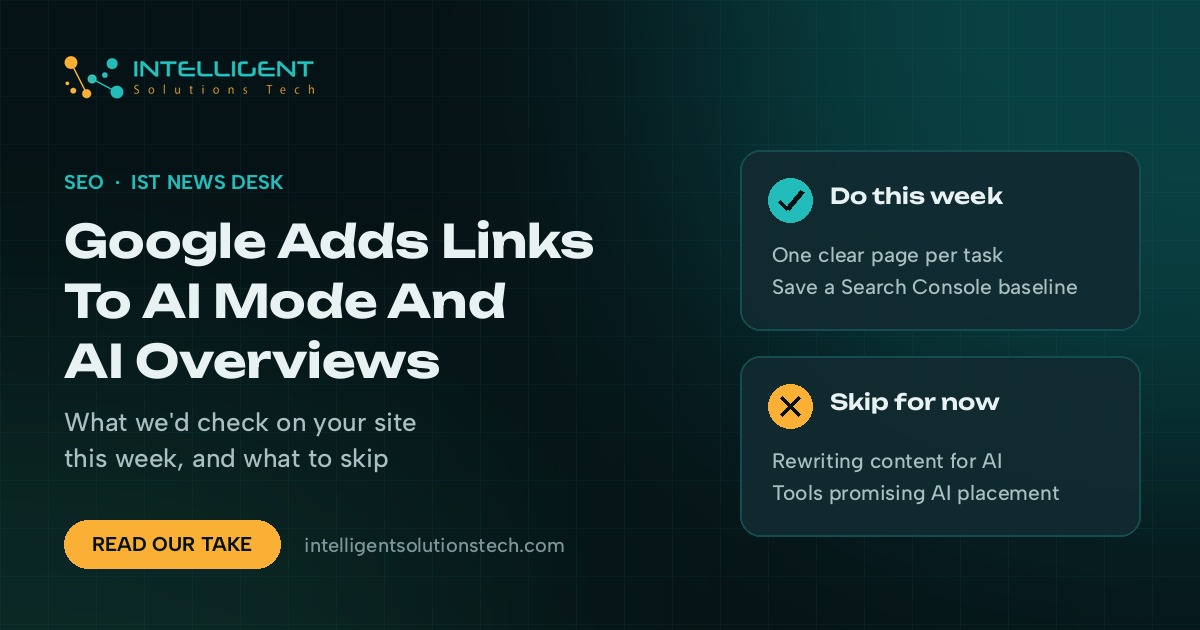
- Search your own brand plus your main tasks in AI Mode, for example “book [your business]” or “[your business] returns”. Note which URL Google links, if any.
- Give each customer task one clear page with a plain title and heading: booking, pricing, contact, returns, support. Remove duplicate pages that compete for the same job.
- Check that your site name, logo and Organization structured data match your Google Business Profile, so Google can tie the official site to the real business.
- If you publish news or commentary, ask regular readers to add you as a Preferred Source, and say so on your blog.
- Set a baseline now: export four weeks of Search Console queries and landing pages so you can compare in November instead of guessing.
What we’d skip: rewriting articles to “win” AI answers, buying tools that promise AI Overview placement, or changing page titles in a hurry. None of the five changes calls for it.
If you want a second pair of eyes on how your site shows up in AI answers, our SEO service covers exactly this kind of check, and our guide to getting cited in ChatGPT and Google AI Overviews goes deeper on the content side. Local businesses can start with Google Business Profile work. Or request a free SEO audit and we’ll tell you which of your pages Google is most likely to treat as official.