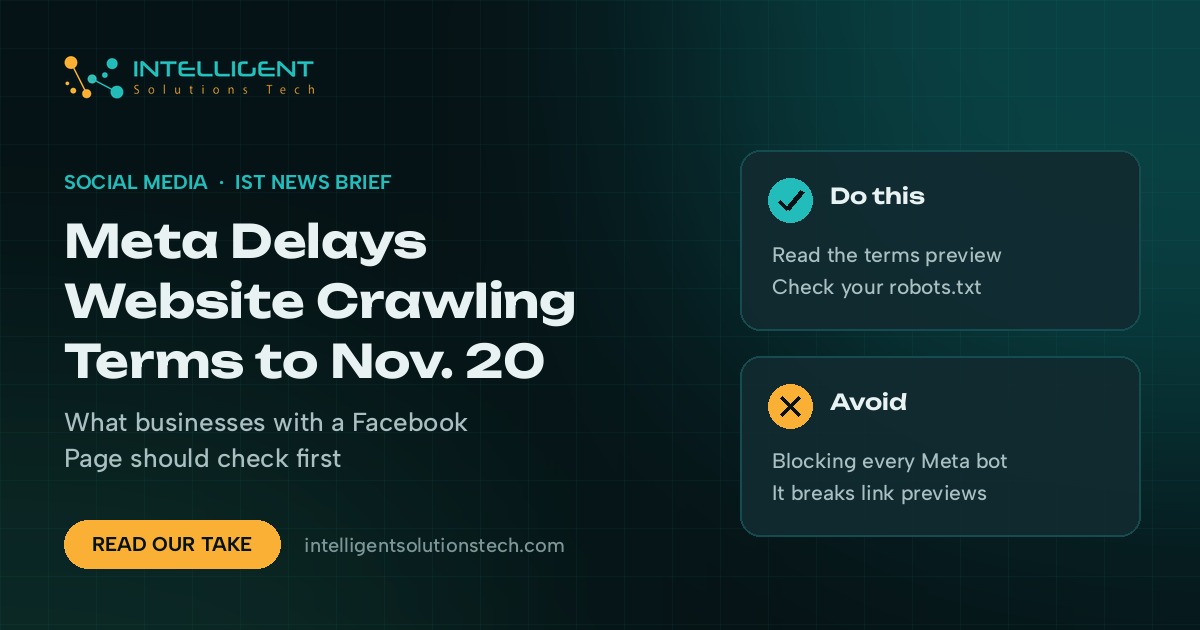
Meta has moved the start date of its updated Commercial Terms and Self-Serve Ad Terms from October 30 to November 20, 2026. A Meta spokesperson confirmed the delay to Reuters on October 23, according to PPC Land, and Search Engine Journal reported that the terms hadn’t otherwise changed. The part drawing complaints is a clause that lets Meta crawl websites tied to businesses that use its tools.
What’s new
- The Meta Commercial Terms apply to business use of Meta’s products, which Search Engine Journal says includes running a Facebook Page.
- The clause lets Meta, or companies acting for it, use automated tools to access, index, cache and collect content from websites associated with a business’s products or services, and to pull updates over time. Search Engine Journal and PPC Land both report it also lets Meta create test credentials to do this.
- PPC Land reports the stated purposes include building and maintaining Meta’s advertising and business products and protecting the security of its platforms. A standalone reference to training was removed from the UK preview on October 23.
- Meta has told reporters that site owners can still use robots.txt to signal crawling preferences. The preview text itself doesn’t mention robots.txt.
- Businesses accept the new terms by continuing to use Meta’s business products after notice.
Who it affects
Any business with a Facebook Page, an Instagram business profile or a Meta ad account falls under these terms. The loudest objections come from news publishers and advertiser groups. Search Engine Journal reports that Movement for an Open Web asked the European Commission and the UK Competition and Markets Authority to block the terms while they investigate, and that the Commission said it would assess the complaint. Meta disagrees with it.
Our take
For a typical local business or online store, we don’t think this is a reason to leave Facebook. Your public product and service pages are already read by plenty of crawlers. We’d use the extra three weeks for two checks.
First, read the terms preview yourself and decide whether anything on your site, such as paid courses, member areas or gated downloads, shouldn’t be collected. Second, compare your robots.txt with Meta’s web crawler documentation. One of Meta’s crawlers fetches the link previews your posts rely on, so a blanket block on Meta will break shared links. If you sell original content, talk to your lawyer before November 20.
Our Facebook management team keeps Pages and ad accounts in order, and our technical SEO work covers robots.txt and crawler access.