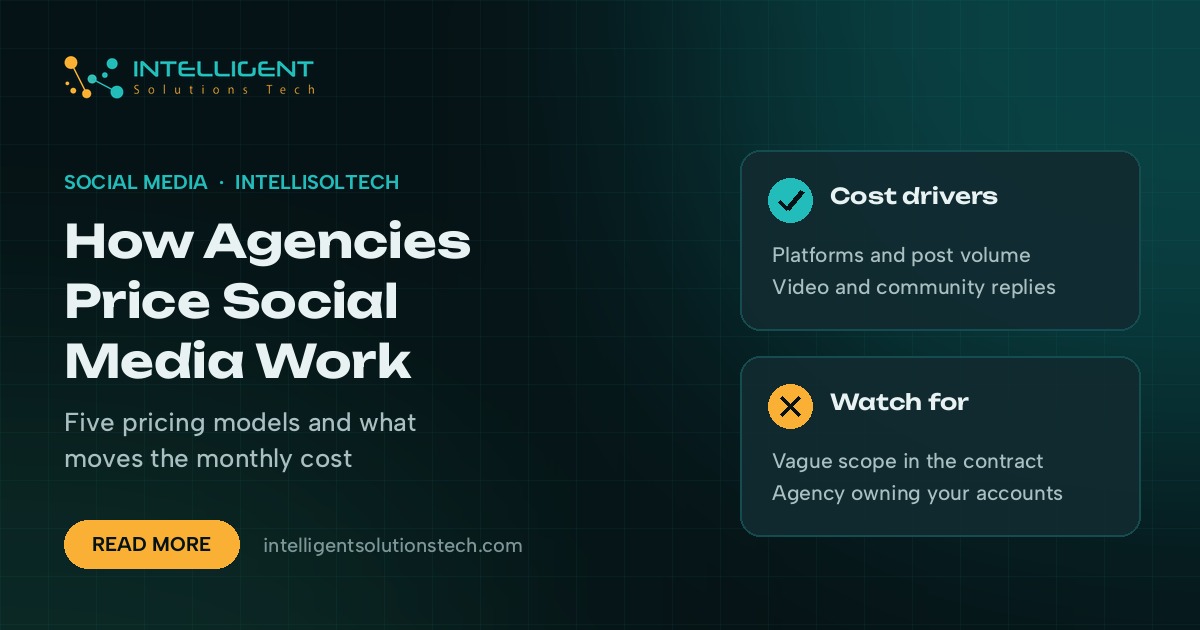
Social media management pricing depends on four things: how many platforms you need covered, how many posts go out each month, who makes the creative, and whether the agency handles comments, messages and ads on top of posting. Two quotes that look far apart are often just covering different amounts of work.
Most agencies charge a fixed monthly retainer for an agreed scope. Some charge per post, per platform or by the hour, and a few add a setup fee for the first month. The model matters less than the scope behind it, so the useful question is what each line of a quote actually buys.
This guide walks through the common pricing models, the cost drivers that move a quote up or down, and the questions to ask before you sign. If you want a quick estimate for your own setup, our social media pricing calculator builds one from your platforms and posting volume.
What social media management covers
Social media management is the ongoing work of planning, creating, publishing and monitoring content on a business’s social accounts. A full-service package usually includes a content calendar, written captions, designed graphics or short videos, scheduling, community replies and a monthly or biweekly report.
Not every agency includes all of that. Some only schedule content you supply. Others create everything but leave comments and direct messages to you. Paid ads are almost always a separate line, and the ad spend itself is paid to the platform, not the agency.
The five common pricing models
1. Monthly retainer
This is the most common model. You pay a fixed amount each month for a defined scope, such as three platforms, a set number of posts per week, one round of revisions and a report. It’s predictable for both sides, and it’s the easiest model to budget around.
The risk is a vague scope. If the contract just says “social media management” without listing platforms, post counts and response times, you’ll end up arguing about what’s included.
2. Per-platform pricing
Some agencies price each platform separately, so adding Instagram to a Facebook package adds a fixed amount. This works well when you’re starting with one channel and plan to add more later.
3. Per-post or per-asset pricing
Freelancers and content studios often charge per post, per carousel or per short video. It’s flexible and fair for small volumes. It gets expensive and hard to forecast once you’re posting daily across several channels.
4. Hourly billing
Hourly billing is common for consultants and strategy work, like an account audit or a one-off content plan. For ongoing posting it’s the hardest model to budget, because the hours vary month to month and you rarely see what each hour produced.
5. Tiered packages
Many agencies publish starter, growth and premium tiers. Tiers make comparison easier, but read the limits on each one. A lower tier might cap revisions, exclude video or leave community management out entirely.
What drives the monthly cost
When two quotes for the same business come back far apart, one or more of these factors is usually the reason.
- Number of platforms. Each platform needs its own format, caption length and posting rhythm. LinkedIn, Instagram, Facebook and TikTok rarely share one asset without changes.
- Posting volume. Three posts a week on two platforms is a very different job from daily posting on four.
- Content type. Text and static graphics are the cheapest to produce. Carousels take longer, and short-form video with editing, captions and music takes the most time.
- Who supplies the raw material. If you send photos, product shots and talking points, the agency spends less time on research and shoots.
- Community management. Replying to comments and DMs within set hours is ongoing labor, often a separate line item.
- Paid social. Running ads adds campaign setup, audience building, testing and reporting. Ad spend sits on top.
- Approval rounds. A single reviewer with one round of edits costs less to serve than a committee with three.
- Reporting depth. A screenshot of follower counts is quick. A report that ties posts to website visits and leads takes real analysis.
How AI has changed social media pricing
AI writing and design tools have cut the time it takes to draft captions, resize graphics and plan a month of posts. Agencies that use them well can produce the same volume with less labor, and some pass that saving on through lower retainers or higher post counts for the same fee.
What AI doesn’t remove is judgment. Someone still needs to know your customers, check facts, keep the brand voice consistent and decide what’s worth posting. Be wary of packages that promise huge volume with no human review, because generic posts can do more harm than posting less often.
We run AI social media management this way: AI handles the drafting and resizing, and a person plans, edits and approves every post before it goes out.
Retainer, freelancer or in-house?
Price per month is only part of the comparison. Here’s how the common setups differ on the things that tend to matter.
- Agency retainer. You get a team covering strategy, writing, design and reporting under one contract. Cover for holidays and sick days is built in. It costs more than a single freelancer for the same post count.
- Freelancer. Often the lowest cost for one or two platforms. Quality depends on one person’s skills and availability, and design or video may need a second hire.
- In-house hire. Full control and fast turnaround, plus salary, benefits, software subscriptions and management time. It makes sense once social is a major sales channel for you.
- Offshore agency. Agencies in places like Pakistan or the Philippines can cover the same scope at lower cost. Check time-zone overlap, approval workflow and who owns the accounts before you sign.
Questions to ask before you sign
A good quote answers these without you having to chase. If it doesn’t, ask in writing.
- Which platforms are included, and how many posts per week on each?
- Who creates the graphics and video, and how many revision rounds are included?
- Are comments and direct messages handled? During which hours?
- Is paid advertising included, and is ad spend billed separately?
- What does the report show, and how often will I get it?
- Who owns the accounts, the content and the design files if we stop working together?
- What’s the notice period, and is there a minimum term?
Account ownership is the one people forget. Your business should own every social account and ad account, with the agency added as a manager or partner. Meta Business Suite and LinkedIn Page admin roles both support this.
How to compare quotes that look different
Put each quote into the same simple table: platforms, posts per week per platform, content types, community management, ads, reporting frequency and monthly fee. Gaps jump out fast once the scope sits side by side.
Then work out a rough cost per post for the posting part of each quote. It won’t be exact, because strategy and replies don’t map neatly onto posts, but it shows whether a cheaper quote is cheaper because it covers less.
Finally, ask each agency for a sample content calendar for your business. Planning a month of posts in one sitting is a good test of whether they understand your offer. Our guide on how to plan a month of LinkedIn and Facebook posts shows what a solid calendar looks like.
Get a scope and price for your accounts
We price social media management after a free audit of your current accounts, then send a written proposal with a fixed monthly scope: platforms, post counts, content types and reporting. To get a starting figure first, run your numbers through the social media pricing calculator.