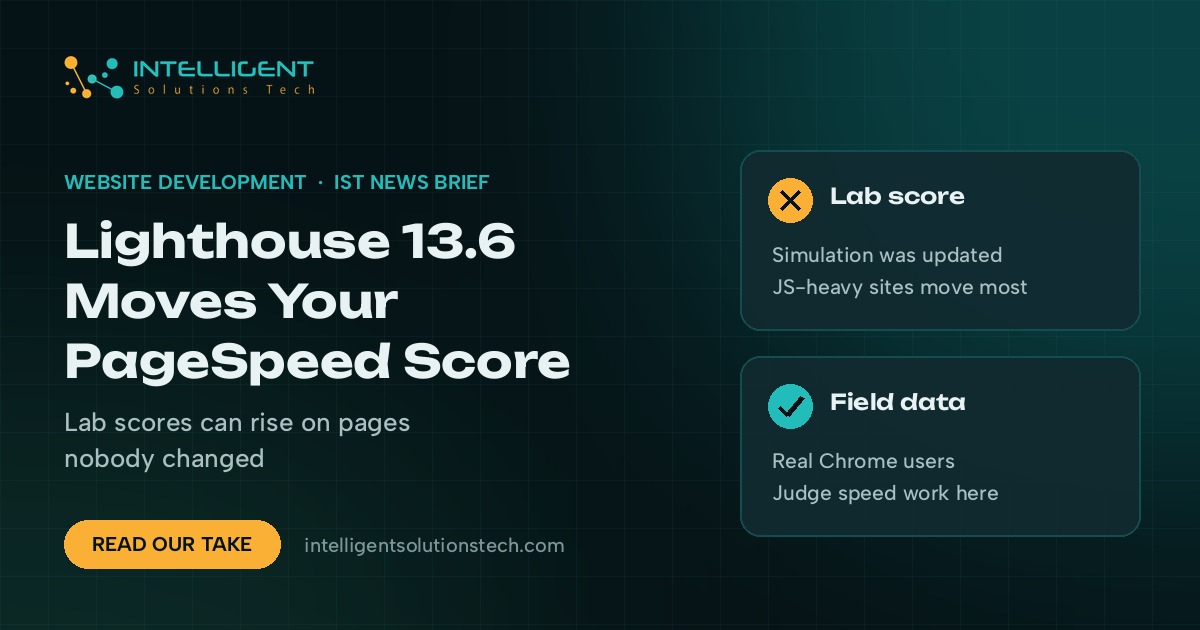
Google’s Lighthouse team released Lighthouse 13.6.0 on October 27, and the release notes say it should reach PageSpeed Insights within a week. The update changes how Lighthouse simulates a page load on a slow connection, so your PageSpeed Insights score can move even if nobody touched the site. Barry Pollard, who works on web performance at Google, said on Bluesky that the new numbers are more accurate and generally higher, according to Search Engine Journal.
What’s new
The Lighthouse 13.6.0 release notes list several changes to Lantern, the engine that estimates load times for the mobile lab test:
- Lantern now reads Chrome’s own render-blocking status for each request instead of guessing from its priority.
- When the largest element is text painted in the same frame as the first content, simulated LCP is worked out from the same data as First Contentful Paint.
- HTTP/3 connections, redirects and connection timing are modeled more closely.
- The Agentic Resource Discovery audit now follows version 0.91 of that spec, with ard.json replacing the older ai-catalog.json file name.
The same version is expected in Chrome DevTools with Chrome 159. Pollard said JavaScript-heavy sites are the most likely to see a change. An open GitHub issue is still looking at cases where simulated LCP runs far above the measured number on large JavaScript apps.
Who it affects
Anyone who tracks a PageSpeed Insights score in a report, a dashboard or a monthly email from a vendor. The lab score is a simulation. The field data block at the top of the report comes from real Chrome users over the last 28 days, and a Lighthouse release doesn’t change what those users experienced. If your chart jumps this week, the tool changed, and your site may not have.
Teams comparing two reports should check the Lighthouse version printed at the bottom of each. A report run before the update and one run after it aren’t measuring the page the same way.
Our take
Treat any score change in the first week of November as noise until you’ve looked at field data. We’re adding a note to client speed reports that marks the switch to 13.6, so nobody credits or blames a site change for it. If your field data for LCP or INP is still in the red, the higher lab score doesn’t fix that, and the work on images, scripts and hosting still matters. Our guide on speeding up a WordPress site covers the usual fixes, and our technical SEO audits read field data first.
If your Core Web Vitals need real work, our website speed team can take a look, starting with a free audit.