Anthropic released Claude Haiku 5.5 on October 7, and for most small businesses running AI chatbots or automations, this is the model release that matters more than the flagship launches. On its Haiku 5.5 announcement page, Anthropic lists API pricing of $0.10 per million input tokens and $0.50 per million output tokens for prompts up to 100,000 tokens. Haiku 4.5 cost $1 and $5.
Our view is simple. If you pay per token for a support bot, an email triage flow or a lead-scoring step, Haiku 5.5 is worth testing this month. Test it before you switch, though, because the cheaper sticker price comes with a new tokenizer and a model that always reasons, and both change what a real job costs.
We’re telling clients to run a side-by-side test on their own data, compare the full bill per task, and only then move production traffic.
What changed
Claude Haiku 5.5 is Anthropic’s new small model, built for high-volume work like summarizing, classifying, answering routine questions and running as a helper inside larger agent setups. Anthropic says it’s available now through its own API under the model ID claude-haiku-5-5, and on Amazon Web Services, Google Cloud and Microsoft Azure.
The headline is price. Anthropic says Haiku 5.5 costs about 75% less to run than Haiku 4.5 on average: roughly 90% cheaper for requests up to 100,000 tokens and about 50% cheaper above that. Past 100,000 tokens, the per-token price rises fivefold to $0.50 input and $2.50 output.
Two details matter for anyone with a working automation:
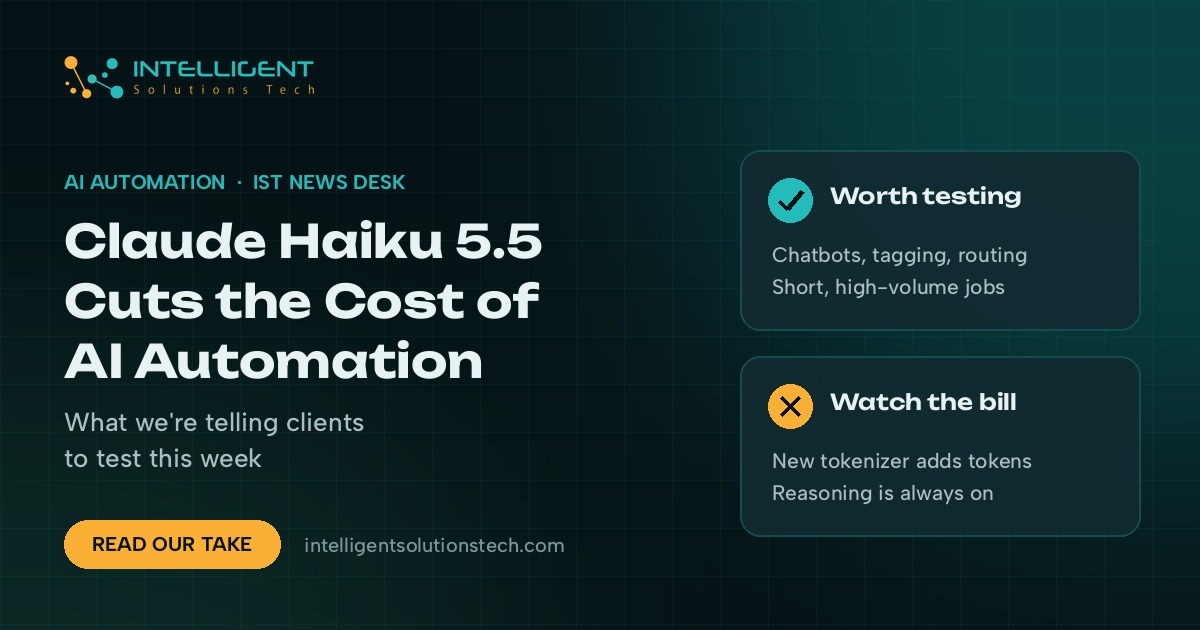
- A new tokenizer. Anthropic’s own footnote says the model uses slightly more tokens per task. Developer Simon Willison measured one long prompt at about 1.25 times the tokens it used on Haiku 4.5.
- Reasoning is always on. Haiku 5.5 is the first Haiku-class model with an adjustable effort setting. Willison reports that it defaults to medium effort and that reasoning can’t be switched off, so short answers may take longer and use more output tokens than before.
Anthropic also cut Sonnet 5.5 cache-read pricing in half, which it says lowers the cost of most agentic work on that model by about 20%. On benchmarks, Anthropic shows Haiku 5.5 well ahead of Haiku 4.5 but still behind Sonnet 5.5, and it recommends Sonnet 5.5 for complex coding agents.
What it means for your business
For a small business, the cost of an AI workflow usually comes from volume, not difficulty. A chatbot that answers order-status questions, a flow that tags inbound emails, or a step that pulls fields from invoices runs hundreds or thousands of times a month. Those are the jobs Haiku 5.5 is aimed at, and the price drop applies to almost every one of them because they rarely come close to 100,000 tokens.
Where we’d be careful is the gap between list price and real cost. A tokenizer that counts more tokens for the same text, plus reasoning tokens on every call, can eat part of the saving. On a short classification task the result can still be far cheaper. On a long-document job that crosses the 100,000-token line, the math looks very different.
Quality is the other half. Anthropic’s benchmark table points to a real jump over Haiku 4.5, and HubSpot, Box and Asana shared early results on the same page. Those are vendor-published numbers on vendor-chosen tests. Your own prompts and your own customers’ questions are the test that counts.
If you’re on a no-code platform like Zapier, Make or n8n, check whether your Claude step lets you enter a model ID or only pick from a fixed list. That decides how fast you can test. Our Claude AI integration work usually starts with exactly this kind of model check.
What we’d do this week
- List every workflow that calls a Claude model, the model it uses today and roughly how many calls it makes each month.
- Pick the two highest-volume, low-risk jobs (tagging, summarizing, routing) and run 50 to 100 real past inputs through Haiku 5.5 next to your current model.
- Compare full cost per task from the usage logs, including reasoning tokens, and not just the per-million price.
- Try the low effort setting on simple jobs. Keep medium or higher only where answers get noticeably worse.
- Leave customer-facing replies and anything involving refunds, legal or medical wording on your current model until a person has reviewed a sample of Haiku 5.5 outputs.
If you’re on Sonnet 5.5 and use prompt caching heavily, check your next invoice too. The cache-read cut may lower your bill without any change on your side.
Our take
This is a useful release for businesses that already run AI automations, and a good reason to revisit chatbot or document jobs you shelved because the per-call cost didn’t work. It isn’t a reason to rebuild anything in a hurry. A one-week test on your own data will tell you more than any benchmark chart.
If you want help sizing that test, our AI workflow automation team can review your current flows, and the automation ROI calculator gives a quick read on which jobs are worth moving. You can also start with a free audit.