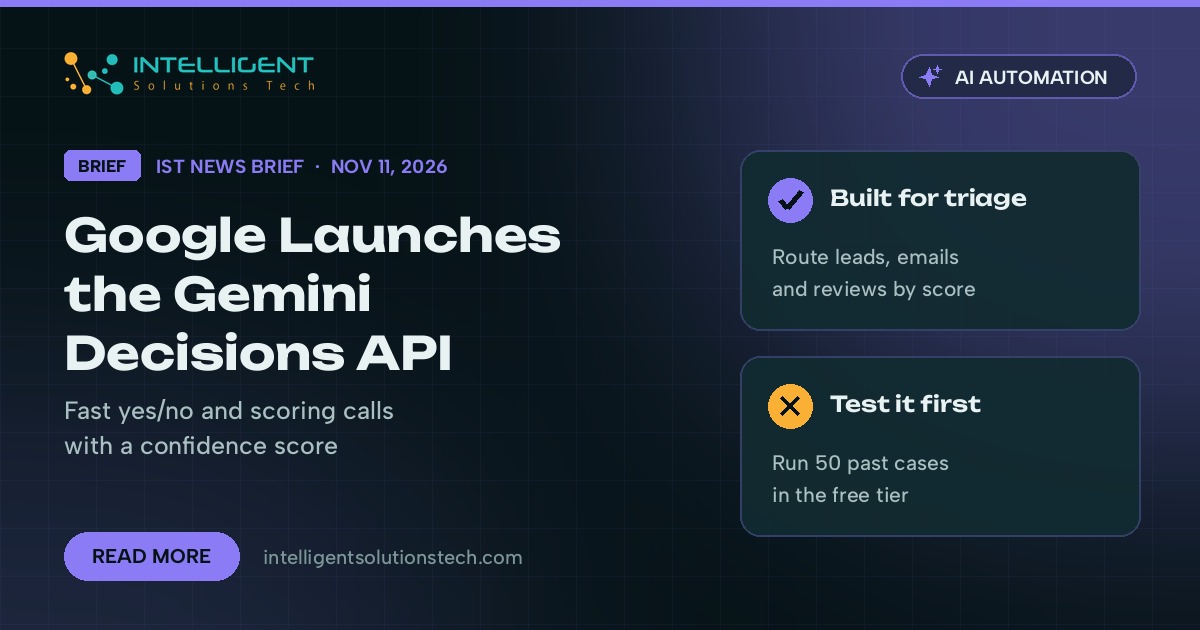
Google announced the Gemini Decisions API on November 11, 2026, on its official blog. It runs on a new model called Gemini Decision 1 and does one narrow job: it answers fixed questions about an input and returns probabilities with a confidence score, rather than writing text. Developers can try it today through Google AI Studio and the Gemini API.
What’s new
Google said the API handles three kinds of questions: yes or no, multiple choice with 2 to 255 options, and a weighted score against a rubric you define. One request can check a single input, such as an email, a PDF, an image or a short video, against up to 1,000 questions at once, and each answer comes with a confidence score from 0 to 1.
- Google reports response times of roughly 150 to 250 milliseconds.
- Google lists pricing at $0.10 per million input tokens, with no charge for output, and a no-cost tier in AI Studio for testing.
- Google said it already uses the API inside its own products, including routing questions in Gemini Notebook.
- Support through Google Cloud is listed as coming soon, and connectors for LangChain, Vercel, OpenRouter and LiteLLM are rolling out.
Who it affects
This is a developer tool, so nothing changes in your Gmail, Sheets or ads accounts. It matters to any business that runs automations with a sorting step in the middle: deciding whether a form fill is a real lead, which team a support email belongs to, whether a review needs a reply today, or whether an invoice matches a purchase order.
Most teams do that today with a full chat model and a prompt that says “answer only yes or no”. That works, but it is slower and harder to trust, because you get a word back with no sense of how sure the model was.
Our take
We like this one because the confidence score solves a real problem in triage automations. You can let the API handle the clear cases and send anything below, say, 0.8 confidence to a person. Before you rebuild anything, pull 50 past emails or form fills, run them through the free tier in AI Studio, and compare the answers with what your team actually decided. If it matches on most of them, it is worth wiring into your Zapier, Make or n8n flow.
If you want help building that kind of triage step, our lead qualification automation and AI agents teams do this work, and we covered Google’s recent model news in our post on Gemini 4 Carbon. Google’s announcement is on the Google blog.