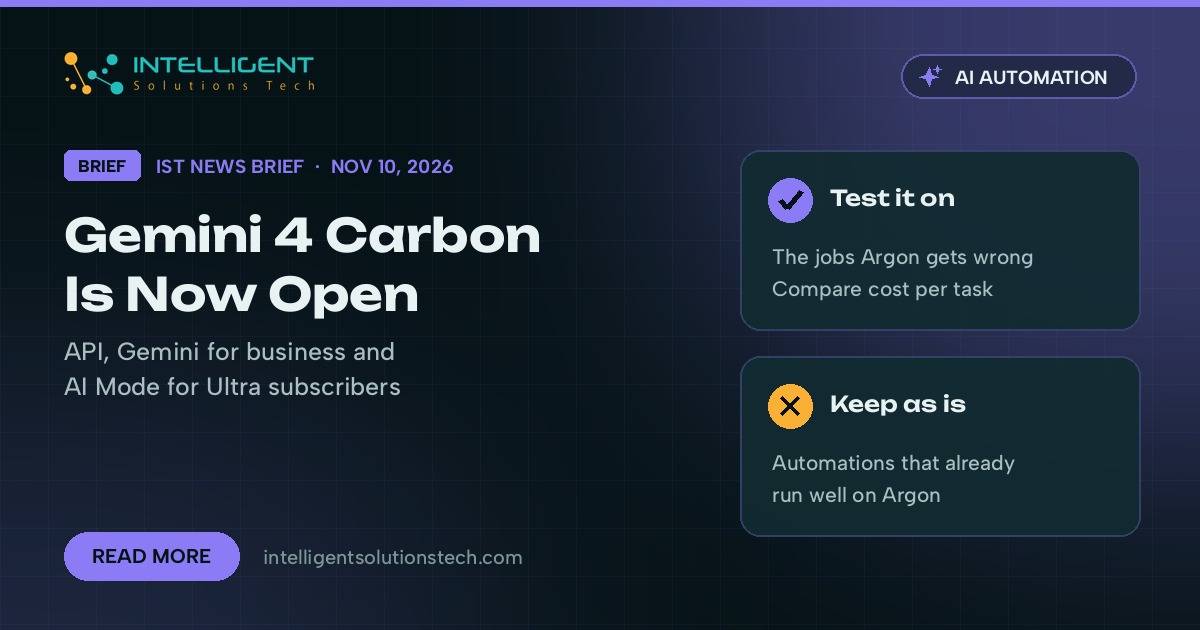
Google made Gemini 4 Carbon, its strongest AI model, widely available on November 10, 2026. In a post on Google’s blog, Google DeepMind said Carbon is now in the Gemini API through Google AI Studio and in Gemini for business for all paying developers and enterprises. It’s also rolling out to Google AI Ultra subscribers in the Gemini app, Google Antigravity and AI Mode in Search. When Google first announced Carbon on October 28, only a small group of security testers could use it, which is the stage our first take covered.
What’s new
- API access for all paying developers, at the same introductory price as Gemini 4 Argon. Google lists that as $2 per million input tokens and $10 per million output tokens.
- Access for Google AI Ultra subscribers in the Gemini app and in AI Mode in Search.
- A preview of a /swarm command in Google Antigravity that turns one prompt into a team of coordinated agents.
Google also said Argon remains the better choice for most coding and knowledge work. Carbon spends more tokens working through harder, multi-step problems, so it costs more per task even at the same token price.
Who it affects
This matters most for teams that build on the Gemini API, agencies that run AI agents for clients, and businesses on Gemini for business plans. Most owners on free or standard Gemini plans won’t see Carbon yet, and AI Mode users outside the Ultra tier keep the usual models.
If you run a chatbot or an automation on a pinned Gemini model, nothing changes on its own. Carbon is a separate model you have to choose, so your current setups keep running as they are until someone switches them.
Our take
Google’s advice lines up with ours: Argon stays the default. We’d leave working automations on the model they run on today and test Carbon only on the jobs Argon gets wrong, like long document reviews or multi-step data cleanup. If you wrote down a short test set after the October announcement, run it now and compare the cost per task before you switch anything.
Want help testing models against your own workflows? Our AI agents team runs these comparisons as part of our AI workflow automation work.