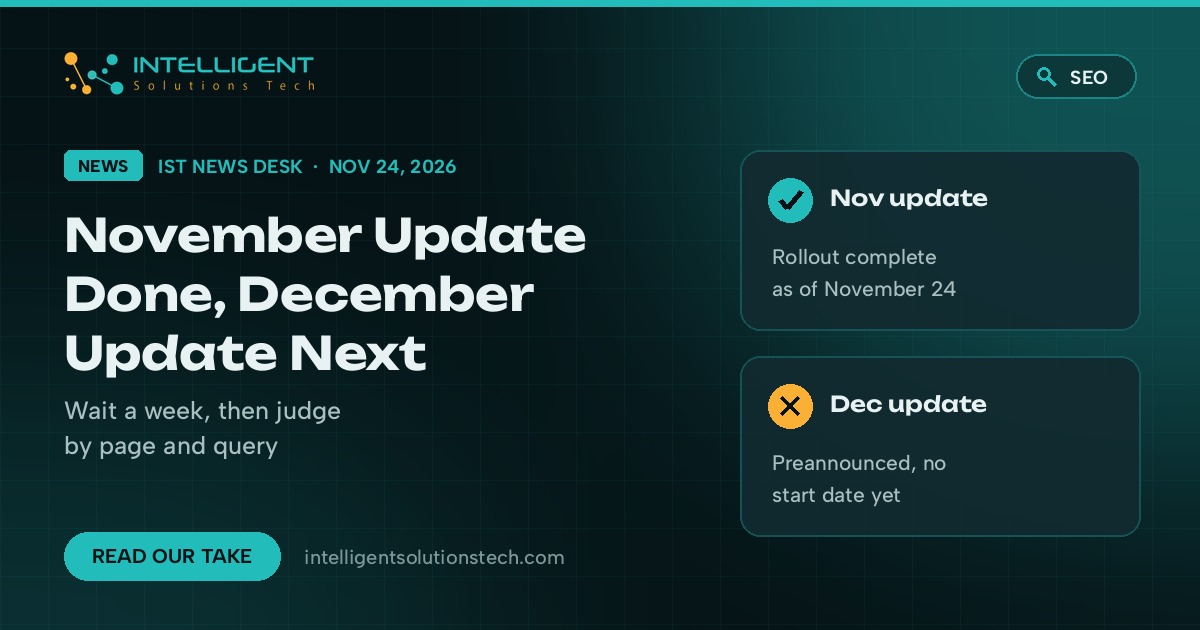
Google finished rolling out the November 2026 core update on November 24, according to its Search Status Dashboard, two weeks after it began on November 10. About an hour later, Google posted notice of the next one. The December 2026 core update is now listed on the dashboard as scheduled for December, with no start date yet.
For site owners, that changes the calendar more than the playbook. We’re telling clients to treat the next week as a measurement window, judge the November update on clean data, and use the weeks before December to fix what that data shows. Rewriting pages in a hurry now would only blur what each update did.
Google also opened a Search ranking hub on Search Central the same day, with a new way to send feedback about ranking updates from inside Search Console. That part is easy to miss and worth knowing about.
What changed
The November update is complete. Google’s dashboard says the rollout was complete as of November 24, 2026. A new Search Central page asks site owners to wait until an update is marked complete, plus at least a week of post-rollout data, before judging traffic changes in Search Console.
The December 2026 core update is on the way. Google said it focuses on how its systems understand and rank relevant content, including longer and more complex questions, and on improving personalized results for people who have personalization turned on. It applies to every location and language where Search is available. A Google spokesperson told Search Engine Roundtable there’s no date yet, that it isn’t imminent, and that Google will announce it the day it starts rolling out.
Advance notice is now written policy. The new page, How to stay informed on Google Search ranking updates, says Google gives notice of actionable policy changes and of broad updates that may cause noticeable ranking shifts. Google ties that notice to the UK Competition and Markets Authority’s fair ranking conduct requirements, which explains why core updates are suddenly getting advance warning.
There’s a formal feedback route. Google’s feedback page says verified site owners can use the Submit Feedback button in Search Console and tag the update with a hashtag such as #NovemberCoreUpdate2026. Google reviews those submissions in aggregate to find systemic problems and says they don’t lead to manual ranking adjustments for individual URLs.
Google-Extended got clearer documentation. Search Engine Roundtable reported that Google’s updated docs restate that using Google-Extended, the control for AI training, doesn’t remove a site from Search results and isn’t used as a ranking signal.
What it means for your business
If your traffic moved between November 10 and today, the update is now a fair suspect, but one bad week isn’t a verdict. Black Friday promotions, holiday shopping and seasonal demand all change search behavior in late November. Compare like with like: the same pages and queries before and after, and the same weeks last year if you have them.
The December update shows where Google is pointing. Longer, more complex questions are the searches AI Overviews and AI Mode already handle, and personalization keeps spreading across Search. Our read is that pages answering a real customer question in full, with details only you can give, are better placed than thin pages built around one keyword. Google hasn’t spelled that out, so treat it as our view.
The advance notice also gives small teams something they rarely get: a few weeks to set a baseline before the next shift lands.
What we’d do this week
- Leave your pages alone until about December 1. That gives you the week of post-rollout data Google recommends.
- Export Search Console data now. Save page and query performance for October 27 to November 9, the two weeks before the update, so you keep a clean baseline before December muddies it.
- From December 1, compare by page and by query, not by total clicks. Look for patterns, such as one section of the site, one page type or one group of questions losing ground.
- List your ten pages that bring in the most leads or sales. Check that each one answers the longer questions customers ask on calls and in emails, and add the details you’d give them in person.
- If you find a clear systemic problem, like copied content outranking your original, send it through Submit Feedback in Search Console with #NovemberCoreUpdate2026 and example URLs. Don’t count on it to restore rankings by itself.
- Subscribe to the Search Status Dashboard RSS feed so you know the day the December update starts.
Our first take, written when the November update began, is here. If you want a second pair of eyes on your November data before December arrives, start with a free SEO audit, or see how our SEO service and technical SEO work handle update reviews.