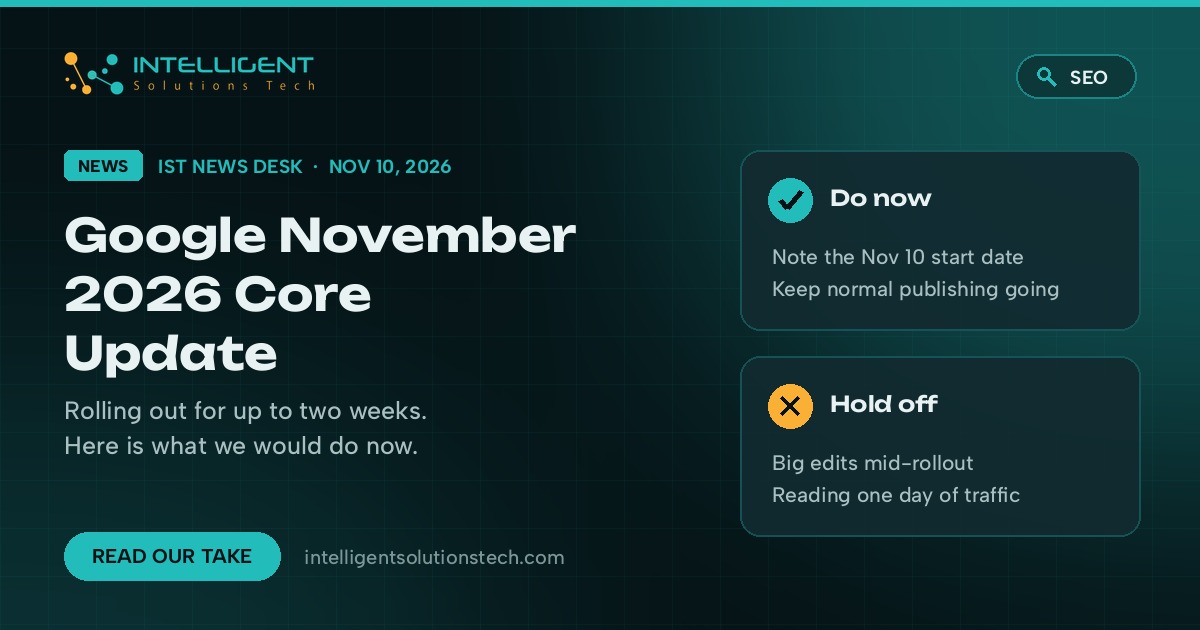
Google started rolling out its November 2026 core update on November 10. The company posted it on the Google Search Status Dashboard at 10:07 a.m. Pacific time, said it applies globally and to all languages, and said the rollout may take up to two weeks.
If your rankings or traffic move this month, this is the most likely reason. Our advice to clients is short: don’t touch pages that are working, don’t start a rewrite while the update is still rolling out, and plan a proper review for early December.
The timing is awkward for stores. Two weeks from November 10 lands on November 24, which is two days before Thanksgiving and three days before Black Friday. That’s exactly when nobody should be making panicked changes to product and category pages.
What changed
Google hasn’t said what this update targets, and with core updates it rarely does. Its core updates documentation describes them as broad changes to its ranking systems that don’t target specific sites or individual pages. The dashboard entry says only that the update was released, that it covers every language, and how long the rollout could take.
Google’s own comparison is a list of favorite restaurants that gets reshuffled as new places open and old favorites slip. A page that drops isn’t necessarily doing anything wrong. Other pages may now look like a better answer for that search.
A few things we can say with confidence:
- This is a confirmed core update, listed on the official Search Status Dashboard.
- It runs for up to two weeks, so rankings can move up and down more than once before it settles.
- Google’s documentation says to wait at least a full week after a core update finishes before you analyze the impact in Search Console.
What we don’t know yet is which kinds of sites will gain or lose. Early ranking-tracker chatter tends to be noisy during the first days, so we’re not reading much into it.
What it means for your business
For most small businesses, a core update is a week or two of wobbly rankings followed by a new normal that’s close to the old one. Google’s documentation says most sites don’t need to worry about core updates and may not notice one happened.
The businesses that do feel it usually fall into two groups. The first has thin service or location pages that say the same thing with a different city name swapped in. The second publishes lots of content written mainly to rank, with little first-hand detail a customer couldn’t find elsewhere. If either sounds familiar, this update is a good prompt to fix it after the rollout ends.
Google draws a useful line in its guidance. A small drop, such as position 2 to position 4, doesn’t call for drastic action, and Google recommends avoiding changes to content that’s already performing well. A large drop, such as position 4 to position 29, calls for a deeper look at whether the site as a whole is helpful and reliable for the people searching.
For online stores the risk is mostly self-inflicted. Changing titles, cutting category copy or restructuring URLs in the week before Black Friday can cost more than the update itself. If a product page slips a few spots, the holiday plan for paid search and email still holds.
Local businesses should keep an eye on the map results too, but a core update is mainly about web rankings. If calls and direction requests from your Business Profile hold steady, a dip in a blog post’s position isn’t an emergency.
What we’d do this week
- Note the start date. Write down November 10 so you can compare the right weeks later.
- Freeze big SEO changes on pages that bring in leads or sales until the dashboard shows the rollout has finished. Fixing broken links, typos or a slow page is fine.
- Keep publishing as planned. A new post or an updated price list is normal site work, not a reaction to the update.
- Bookmark the Search Status Dashboard and check it once or twice a week instead of watching rankings every day.
- Once the update finishes, wait a full week. Then compare that week in Search Console with the week before November 10, page by page and query by query.
- If you see a large, sustained drop, review the hardest-hit pages against Google’s self-assessment questions. Improve them for readers first. Deleting content should be the last option, not the first.
For stores, add one more step: get any planned holiday changes to product pages, titles and structured data done now, or hold them until December. Don’t ship them mid-rollout and then guess whether the update or your edits moved the numbers.
If you want a second set of eyes, we look at core update impact the same way every time. We compare clean before-and-after windows, separate web results from image and video results, and look for patterns across page types before suggesting any rewrite. Our SEO team handles this for clients in the US, UK, Canada, Europe and Australia, and our technical SEO work covers the crawl and indexing side that sometimes gets blamed on an update. Store owners can see how we handle product and category pages on our ecommerce SEO page.
Our last update write-up, on the September 2026 spam update, followed the same rule: wait for the rollout to end, then measure. If you’d like us to check your site once this one settles, start with a free SEO audit. Google’s announcement is on the Search Status Dashboard.