Google’s September 2026 spam update has finished rolling out. Google started it on September 24, and its Search Status Dashboard now lists the rollout as lasting 13 days and 16 hours, which puts the finish early on October 8, Pacific time. Search Engine Roundtable reported that Google Search Central also confirmed on X that the rollout was complete as of October 8.
Our view is simple. If your traffic held steady, change nothing. If it dropped, this is the week to start reading your data, and next week is soon enough to start fixing things. A spam update rewards sites that clean up real problems, and it punishes panic edits made off one bad day in Analytics.
Below is what Google actually said, what it means for a small business site, and the checks we’re running for our own SEO clients right now.
What changed
Google announced the update on its Search Status Dashboard on September 24 at 9:15 a.m. Pacific. It said the update applies globally and to all languages, and that the rollout could take up to two weeks. It used nearly all of that window.
That length stands out. The dashboard shows the August 2026 spam update finished in under three days and the June 2026 update in about two. This one, the fourth spam update of 2026, ran close to five times as long. Search Engine Roundtable said Google called it a normal spam update and declined to say what share of queries it touched.
Google’s own spam updates documentation covers the rest. Its automated systems, including SpamBrain, look for spam all the time, and spam updates are periodic upgrades to how well those systems catch it. Sites that break the spam policies can rank lower or drop out of results. Google also says fixes don’t pay off right away; its systems can take months to register that a site now complies.
One detail matters for anyone who has bought links. When a spam update neutralizes manipulative links, Google says any ranking boost those links gave you is gone for good. Removing them won’t bring it back.
What it means for your business
Most small business sites have nothing to fear from a spam update. A plumber, an accounting firm or a Shopify store with honest service pages and real reviews isn’t the target. Spam updates go after things like scaled pages written only to rank, hidden text, doorway pages for every suburb in a state, expired domains reused for unrelated content, and paid link schemes.
The risk sits in shortcuts. We see three common ones. The first is a batch of near-identical location pages with the city name swapped. The second is a blog filled with AI-written posts nobody edited or fact-checked. The third is a link package from a cheap vendor that promised a jump in domain authority.
Google updated its site reputation abuse policy on August 28, according to the Search Central blog. If you rent out a section of your site to a third party publishing coupons, reviews or affiliate content, read that policy alongside this update.
A ranking drop during the last two weeks also doesn’t prove the spam update caused it. Search Engine Roundtable noted it couldn’t rule out other Google changes during the rollout. Seasonal demand, a site migration or a broken tracking tag can look the same in a traffic chart.
What we’d do this week
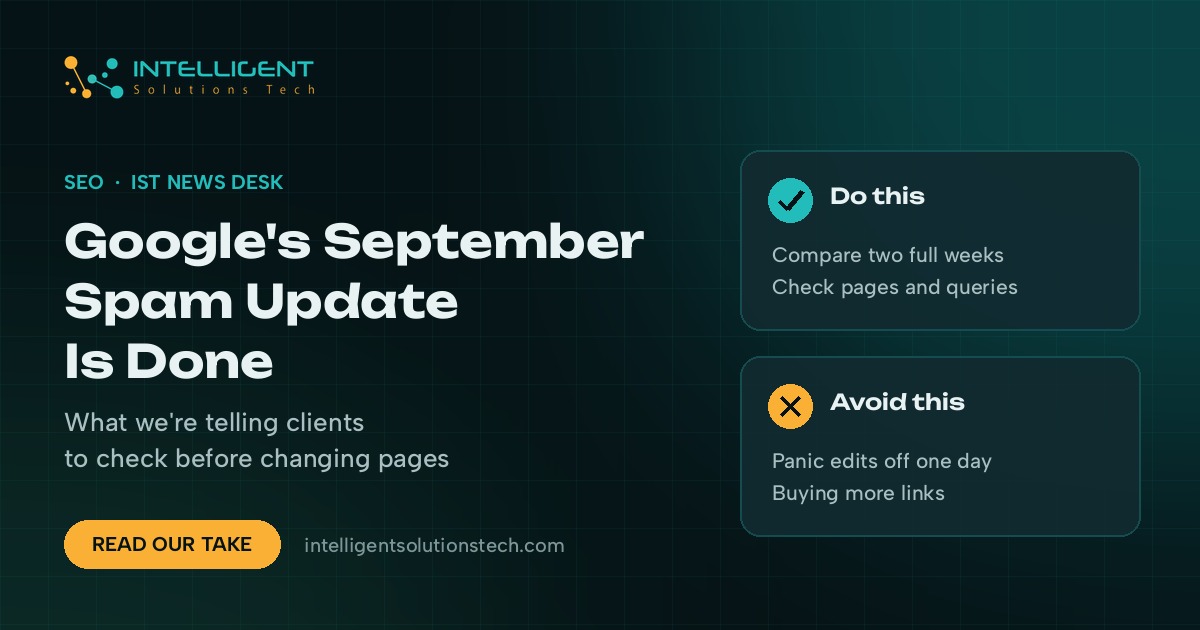
- Wait for clean data. Compare the two full weeks after October 8 with the two weeks before September 24 in Search Console. Don’t judge by a single day.
- Look at pages and queries, not totals. In the Performance report, sort by clicks lost. If the drop is spread evenly across the site, think about demand or tracking first. If it’s concentrated on a set of thin pages, that’s your lead.
- Check Manual actions and Security issues in Search Console. A spam update is algorithmic, but a manual action would show up there and needs a reconsideration request.
- Audit the shortcuts. Read Google’s spam policies and then open your location pages, your oldest blog posts and your backlink list. Merge or remove pages that exist only to rank, and rewrite thin ones with real detail from your business.
- Stop buying links. If you inherited a paid link package, cancel it. Disavowing is rarely needed, and it won’t bring back lost value anyway.
Then give it time. Google says recovery can take months, so measure progress by the next core or spam update, not by next Tuesday.
If you’d like a second pair of eyes on your Search Console data before you change anything, our SEO team can go through it with you. Start with a free SEO audit, and if thin content turns out to be the problem, our content writing service rebuilds those pages properly.