The white label web development process is how one agency builds websites that another agency sells under its own name. Your agency owns the client, the brand and the price. The development partner writes the code, builds the pages and runs the testing, then hands everything back so you can present it as your own work.
When it runs well, your client never sees the partner and your team never gets buried in build work. When it runs badly, you get missed deadlines, pages that don’t match the design and awkward emails you can’t forward. The difference almost always comes down to process, so this post walks through how the work moves from one agency to the other, step by step.
We build sites this way for agencies in the US, UK and Australia, and the steps below are the ones we follow on every project. If you want the service details, our white label web development page covers what’s included.
What white label web development means in practice
White label web development is a delivery arrangement where a partner agency builds the website and the reselling agency delivers it to the end client under its own brand. The partner signs an NDA, works in your tools or neutral ones, and stays out of client conversations unless you ask otherwise.
It’s different from hiring a freelancer for a single task. A white label partner takes responsibility for the full build, from development to QA, and works to your standards and timelines. You keep strategy, design approval and the client relationship.
Step 1: The agency brief
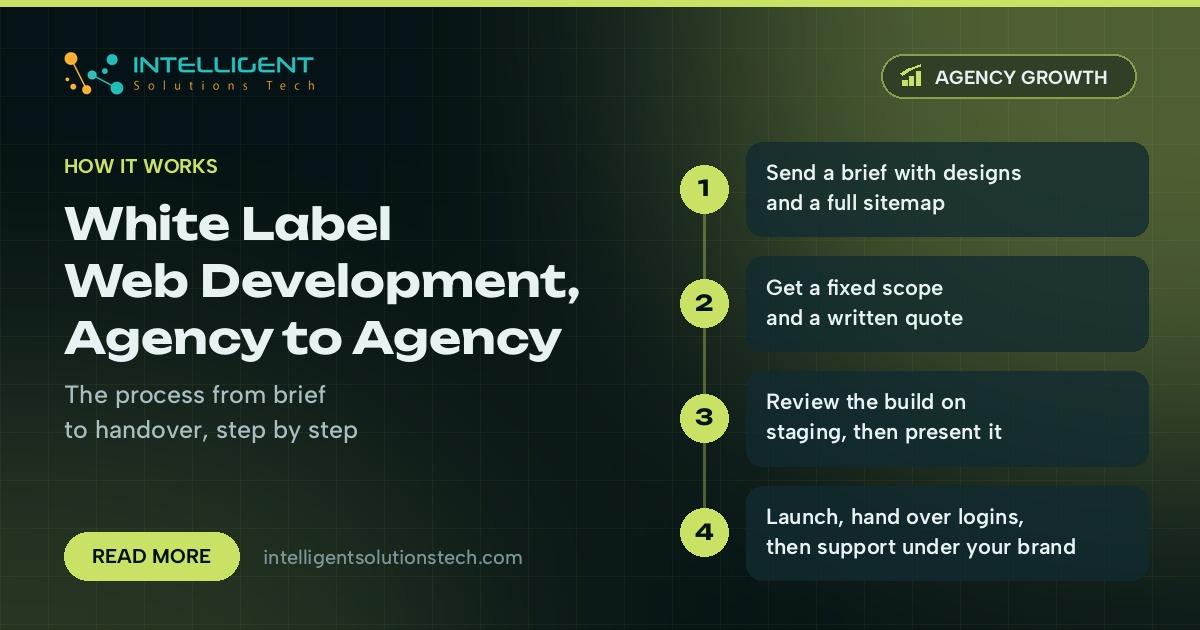
Every project starts with a brief from your side. The better the brief, the more accurate the quote and the fewer revision rounds you sit through later.
- Approved designs in Figma, Adobe XD or a similar file, with desktop and mobile views
- The platform you sold the client: WordPress, Shopify or a custom build
- A sitemap listing every page and template
- Functionality notes covering forms, booking, ecommerce, memberships and multilingual content
- Third-party tools the site must connect to, such as a CRM, email platform or payment gateway
- Content status: final copy and images ready, or placeholders for now
- Hosting details and who controls the domain
- Your deadline and the date the client expects to see a first version
If you don’t have designs yet, say so. Some partners also handle design, while others build only from approved files. Our post on writing a website brief your developer can price has a template you can reuse.
Step 2: Scoping and a fixed quote
The partner reviews the brief and comes back with questions. Expect questions about edge cases: what happens when a form is submitted, which pages share a template, how many product variations a store needs. Good questions at this stage save days later.
Then you get a written scope and price. A fixed scope tied to a page and template list is the safest model for agencies, because you can set your own markup against it and protect your margin. Extra pages or features get quoted as change requests before anyone starts on them.
At IST, work is priced after a free review of your brief. If you want a rough range before you talk to anyone, the website cost calculator gives you a starting point.
Step 3: Setup, access and communication
Before a line of code gets written, both sides agree on how the work will run. Settle these five things in the first week:
- Channel. A shared Slack channel, email thread or project board. Most agencies prefer their own tools so the partner shows up as part of the team.
- Access. A staging server, repository access and logins for any tools the site connects to. Create separate accounts for the partner so you can revoke them when the project ends.
- Branding. The partner uses your agency name in any client-facing material, or stays out of client-facing work entirely.
- Decision owners. One person on each side who signs off. Two approvers on one side slow everything down.
- Updates. How often you get progress reports and in what format.
Sign the NDA and a white label agreement at this point too. It should cover confidentiality, code ownership on final payment, and a rule that the partner won’t contact your client directly.
Step 4: The build on staging
Development happens on a staging site, never on the live domain. The partner builds templates first, then individual pages, then functionality like forms, search and checkout.
Ask for a working link early, ideally once the homepage and one inner template are done. That first review catches design drift while it’s cheap to fix. After that, short written updates every few days keep you informed without pulling your team into daily calls.
A typical WordPress build uses a custom theme with reusable blocks, so your client can edit pages later without breaking the layout. Shopify builds work from a theme with custom sections. Whatever the platform, agree upfront on how much the end client will be able to edit on their own.
Step 5: QA before your team sees it
Quality checks should happen on the partner’s side before you’re asked to review anything. A solid QA pass covers:
- Layout on current Chrome, Safari, Firefox and Edge, plus iOS and Android phones
- Design match against the approved files, including spacing and font sizes
- Every form, with test submissions reaching the right inbox or CRM
- Page speed, image compression and Core Web Vitals on the main templates
- On-page SEO basics: titles, meta descriptions, heading order, alt text and redirects from old URLs
- Accessibility basics like color contrast, keyboard navigation and form labels
- Broken links and 404 errors
If the new site replaces an old one, the redirect map matters as much as the design. Dropping old URLs without redirects is the fastest way to lose rankings after a relaunch.
Step 6: Agency review and client presentation
Your team reviews staging and sends one consolidated list of changes. A shared spreadsheet works, and so do visual feedback tools like BugHerd or Marker.io, which pin each comment to the exact element on the page.
Then you present the site to your client as your own work. The partner should be ready to turn client feedback around quickly, but all of that feedback flows through you. Agree in the scope how many revision rounds are included so nobody is surprised.
Step 7: Launch and handover
Launch day usually means moving the site from staging to live hosting, pointing the domain, checking SSL, submitting the sitemap in Google Search Console and running one more round of form tests. Plan launches early in the week so any problems surface while everyone is working.
Handover should leave you fully in control of the site:
- Admin logins transferred to your agency or the client
- Code in your repository, or a full export of the theme and files
- A short editing guide written without the partner’s name, ready to pass to the client
- A list of plugins, apps and licenses with renewal dates
- A full backup taken right after launch
Step 8: Ongoing support under your brand
Most sites need small changes for months after launch: new pages, plugin updates, speed fixes, new forms. Many agencies set up a monthly support arrangement with the same partner, so the people who built the site keep looking after it.
Ask about response times for urgent issues, how requests are logged, and what happens to unused hours. Time zones matter here too. A team in Lahore shares working hours with UK and European mornings and Australian afternoons, and can cover US mornings with an evening shift or finish fixes overnight so they’re ready when your day starts.
Common mistakes agencies make with white label partners
- Sending a brief without designs or a sitemap and expecting a fixed price
- Letting the end client contact the partner directly
- Skipping the staging review and finding problems at launch
- Leaving code, hosting and logins in the partner’s accounts
- Choosing on price alone and paying for it later in rework
Our guide to outsourcing web development without losing control covers the contract and access side in more detail. If you resell SEO as well, the same principles apply to white label SEO for agencies.
How to tell if a white label web development process is any good
Ask a prospective partner to walk you through a recent project from brief to handover. Look for a written scope, an early staging link, a QA checklist they actually use and a clean handover. Ask to see a sample progress update and a sample editing guide with their name removed.
If a partner can’t show you how they work, they’ll struggle to work inside your process. A short paid pilot, such as a single landing page or one template, tells you more than any sales deck.
Intelligent Solutions Tech was founded in 2018 and works from Lahore with agencies across North America, Europe and Australia, building WordPress, Shopify and custom sites under your brand. See how our website design and development service runs, read about our white label options for marketing agencies, or start with a free audit of a current client site.