Google released Gemini 4 Argon to the public on October 13, 2026, two weeks after it first showed the model to a small group of security teams. Google calls Argon its new frontier model, and it’s now in the Gemini API, the Gemini app and AI Mode in Search for paying subscribers.
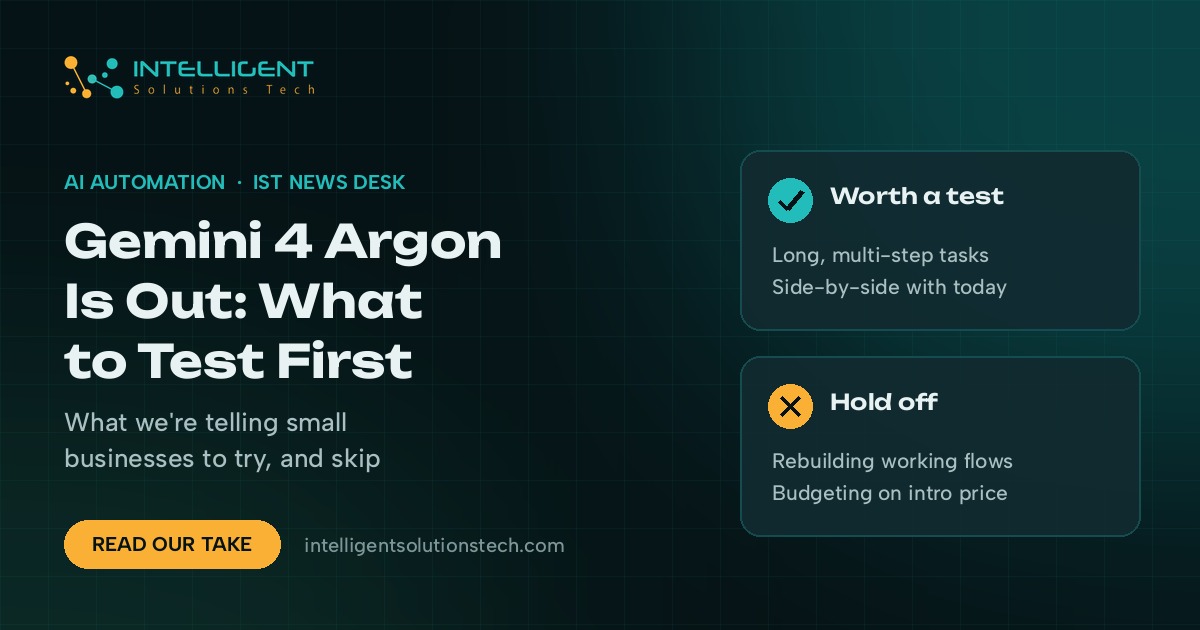
Our view: Gemini 4 Argon is worth testing on the long, multi-step jobs where cheaper models stall, like reconciling a messy spreadsheet or summarizing a stack of contracts. It’s no reason to rebuild automations that already work. And the API price doubles after November 30, so we’re telling clients to budget on the higher number from day one.
For search, nothing changes this week. Argon in AI Mode is limited to Google AI Pro and Ultra subscribers, so most of your customers won’t see answers from it yet.
What changed
Google first announced Gemini 4 Argon on September 30 on its Keyword blog, with access limited to vetted security teams through what it calls the Fairwind Program. On October 13, Google said in its release post that the model is available globally to developers through AI Studio and the paid tier of the Gemini API, and to Google AI Pro and Ultra subscribers in the Gemini app and in AI Mode.
Google lists introductory API pricing of $2 per million input tokens and $10 per million output tokens, with cached input 95% cheaper. After November 30, 2026, Google says the price rises to $4 and $20. The API accepts a combined 1 million tokens of input and output, according to the same post.
Google’s Gemini app post adds two things business owners will notice. Tasks keep working on a request after you close the app, and the app now connects to more than 40 services, with Google naming Shopify, OpenTable, Instacart and Adobe.
Google also reported its own test results. In the September post it said Argon ranked first on Zapier’s AutomationBench, and in the October post it said prompt-injection attacks succeeded 0.7% of the time on the Gray Swan benchmark. Those are Google’s numbers, and independent testing has barely started. Search Engine Roundtable confirmed the model showed up as an option in AI Mode the same day.
What it means for your business
Most small businesses touch AI in three places: a chat assistant for staff, automations that run in the background, and search, where customers find you. Argon reaches all three, though not evenly.
For staff, it’s a paid upgrade. If your team already pays for Google AI Pro, Argon is there now at no extra cost. Teams on Microsoft 365 Copilot or ChatGPT don’t need to switch to try it. A few weeks of side-by-side use on real work will tell you more than any benchmark chart.
For automations, the price and the output limit matter most. A model that writes very long outputs in one pass suits jobs like turning a 40-page supplier contract into a clause-by-clause summary. The introductory price is a poor basis for a business case, though. Most routine steps, like sorting email, tagging leads or pulling fields from invoices, run fine on smaller and cheaper models. We made the same point about Claude Haiku 5.5 last week: match the model to the step.
For search, we’re not changing anything. AI Mode answers from Argon reach paying subscribers only. The work that gets a business cited in AI answers hasn’t moved: clear service pages, accurate business details and content that answers the questions customers actually ask.
On safety, a low prompt-injection score is good news for anyone giving an AI agent access to an inbox or a store. A person should still approve anything that spends money, messages customers or changes prices.
What we’d do this week
- Pick two real tasks your current AI tool handles badly and run them through Argon in the Gemini app or AI Studio. Use identical inputs so the comparison is fair.
- If an automation might move to Argon, cost it at $4 and $20 per million tokens, the rate Google lists after November 30, and check that against your monthly volume.
- Leave working automations alone. Swap a model only after it beats the current one on a test set of at least 20 real examples.
- If you run a Shopify store and try the new Gemini app connection, review what store data it can read, and keep refunds and order edits behind a manual approval.
- Skip any SEO changes tied to Argon and keep checking Search Console on your normal schedule.
Deciding which steps in a workflow deserve a frontier model, and which run fine on a cheaper one, is a big part of our AI workflow automation work. You can run your own numbers through the automation ROI calculator, or start with a free audit and get a written proposal.