Google announced Gemini 4 Carbon on October 28, 2026, two weeks after it shipped Gemini 4 Argon. Google calls Gemini 4 Carbon its strongest model so far and says it was built for long coding and agent tasks and for cybersecurity defense work.
The catch for most business owners is access. Google said Carbon goes first to a subset of cyber defenders through its Fairwind Program, then to more trusted partners in phases. Developers, businesses and consumers get it after Google finishes collecting feedback and tuning guardrails, and Google didn’t give a date.
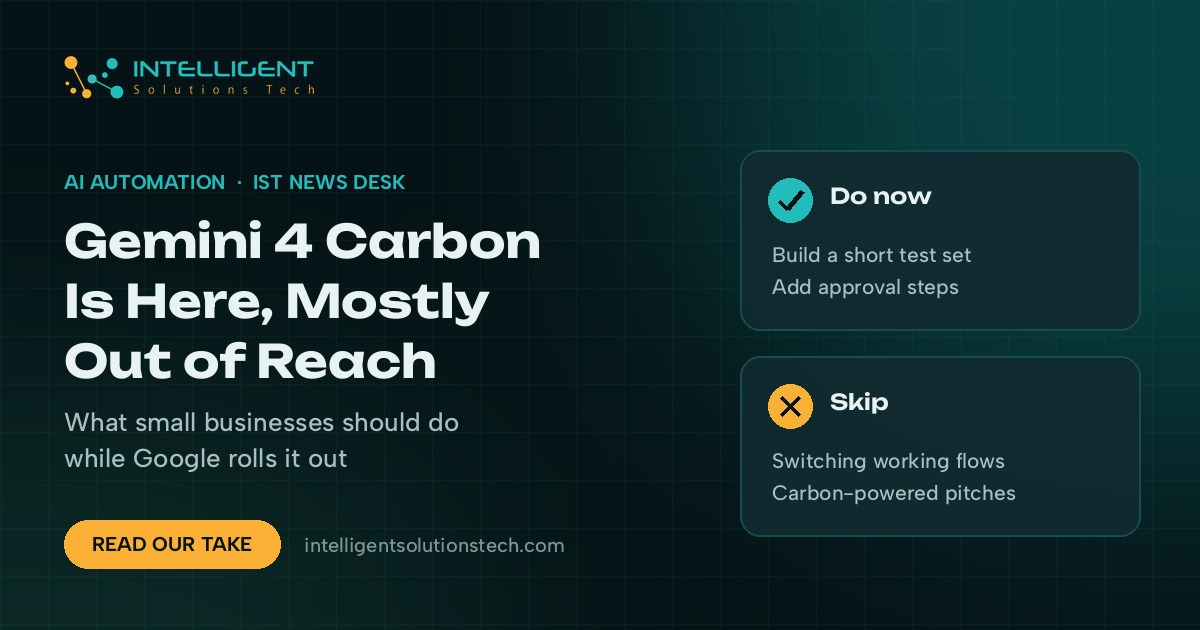
Our view: nothing in your stack needs to change this week. Keep the automations that work on Argon or whatever model you run now, and use the wait to build a short test set so you can judge Carbon on your own tasks the day it opens up.
What changed
Carbon is Google’s new frontier model and sits above Argon. Google’s launch post, written by Koray Kavukcuoglu of Google DeepMind, makes these claims, all based on Google’s own testing:
- Carbon ranks first on version 5.0 of the Artificial Analysis Intelligence Index with a score of 59, according to Google.
- Google reports top scores on three security benchmarks: 88.2% on SEC-bench Pro for finding vulnerabilities, 54.8% on ExploitGym for exploitation and 71.0% on CWE-bench for patching.
- Google says Carbon gained 89 Elo points and now sits fourth on WebDev Arena, which rates web development output.
- In Google’s internal tests, Carbon makes about half as many unsupported claims as Argon, and Google says it blocked every attack attempt in Gray Swan’s indirect prompt injection benchmark.
- Google says Carbon will launch at Argon’s introductory API price of $2 per million input tokens and $10 per million output tokens, moving to $4 and $20 once the introductory period ends.
Every number above comes from Google. Independent testing takes weeks, and benchmark wins don’t always carry over to everyday business work like drafting replies or cleaning up CRM data.
What it means for your business
For now, there’s very little you can touch. Carbon isn’t in the Gemini app, Workspace or the public API for most accounts, and Google hasn’t said when that changes. Anyone selling you a Carbon-powered product this week should be able to explain how they got access.
The direction matters more than the launch date. Google is pointing Carbon at long, multi-step work: an agent that keeps working through a support queue, a data cleanup or a code fix for hours without someone restarting it. If those claims hold up, that’s the kind of job small teams avoid giving to AI today because the model loses track halfway through.
The security focus is the other part to watch. Google describes Carbon finding, testing and patching software flaws, and that cuts both ways for small business websites. Defenders get better tools, while the gap between a flaw going public and someone trying it against your site keeps shrinking. We saw that pattern this month with the PHP2Shell flaws.
Prompt injection resistance matters if you run agents that read email, web pages or customer messages. A model that’s harder to trick with text hidden in an email is safer to connect to an inbox or CRM. We’d still keep a person approving anything that sends money, deletes records or emails customers.
What we’d do this week
- Leave working automations alone. If a workflow runs fine on Argon, GPT or Claude, don’t plan a switch around a model you can’t use yet.
- Write down three to five tasks your current AI setup handles badly. Save the exact inputs. Long tasks that stall halfway are the best candidates, and this becomes your test set.
- Check your API spend. If Google keeps the introductory pricing, Carbon costs the same per token as Argon at launch, so the test comes down to output quality.
- Patch faster. Update WordPress core, plugins and themes at least weekly, and turn on automatic minor core updates if they’re off.
- Review what your agents can do on their own. Any automation that can send email, issue refunds or change records should have an approval step, whichever model runs it.
If you want help building that test set or moving a workflow to a newer model once it’s available, our AI workflow automation team can set it up and run the comparison. Our take on Gemini 4 Argon covers the model you can use today, and a free audit is the easiest way to start.