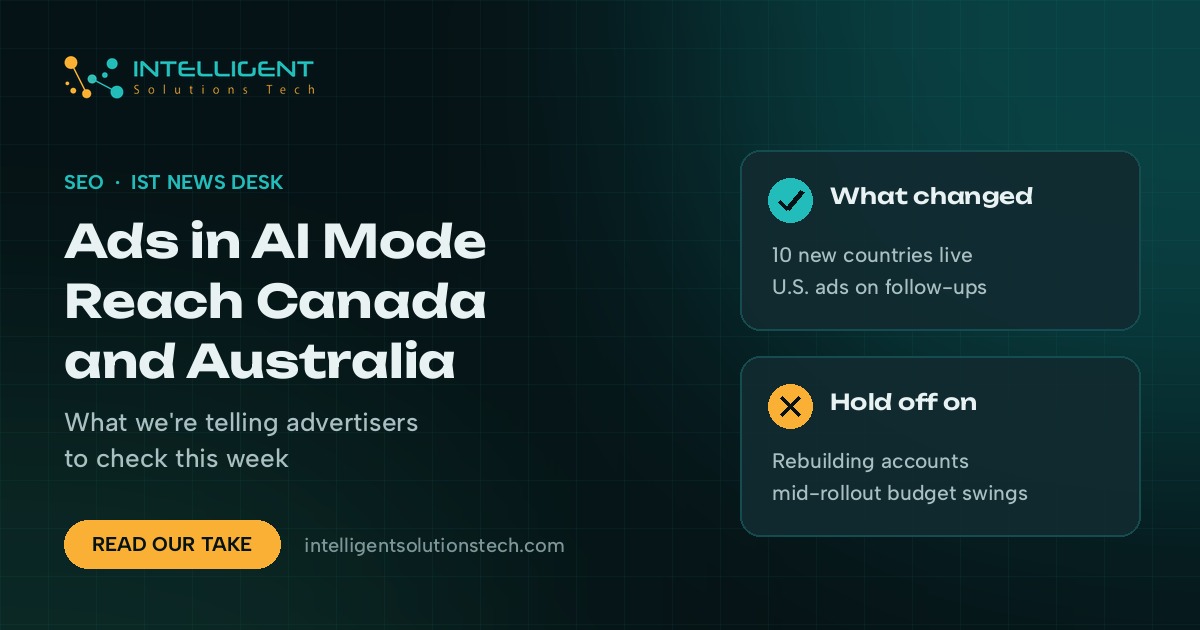
Google is now showing ads in AI Mode in Australia, Canada, New Zealand and seven other countries, and it has started placing ads on follow-up questions inside AI Mode conversations in the U.S. Shashi Thakur, Google’s VP and GM for Search Ads, announced both changes on the Google Ads and Commerce blog on October 28, 2026, and said the U.K. is on the list for later in Q4.
For advertisers in those markets, ads in AI Mode stop being a U.S. curiosity and become part of the auction your budget already sits in. Our view is calm: you don’t need a new campaign type, and you shouldn’t panic-rebuild accounts this week. You do need to know which of your campaigns can show there and how to read the numbers, because Google folds them into the reports you already use.
What changed
The new countries are Australia, Canada, India, Kenya, Malaysia, New Zealand, Nigeria, Pakistan, the Philippines and Singapore. Google said it plans to add more locales in Q4 2026, naming Brazil, Mexico and the United Kingdom. Search Engine Roundtable noted that Google first put ads in AI Mode in May 2025, so this is an expansion of an existing format, with U.S. accounts having had the longest run with it.
The second change is multiturn ads in the U.S. Until now, the obvious place for an ad was the first answer. A Google spokesperson told Search Engine Roundtable that multiturn ads appear on responses to follow-up queries as people keep the conversation going. Every ad carries a “Sponsored” label.
Google backed the move with two of its own numbers. It said AI Mode queries are on average three times longer than traditional searches, citing its U.S. AI Mode report from May 2026. It also said click-through rates are similar between sponsored and organic product listings in AI Mode, based on internal U.S. data from late August to early September. Those are Google’s figures about its own product, so treat them as a claim to test in your own account.
The Google Ads help page on ads in AI experiences fills in the mechanics:
- Existing Search, Shopping and Performance Max campaigns are eligible automatically. There’s no separate budget or opt-in.
- Text ads and Shopping ads can appear. Google says it’s testing other types, including local inventory ads.
- AI Max for Search, broad match, Shopping and Performance Max can match to the query and to the AI answer itself. Exact and phrase match keywords only show when the query already has clear commercial intent.
- Negative keywords and asset pinning still apply.
- Results are blended into your normal campaign and search terms reports, without a separate AI Mode column.
- Some ads may appear with short “AI explainers” written by Gemini from your site and other public sources. Advertisers can’t edit or opt out of them.
What it means for your business
If you run Google Ads in Canada or Australia, some of your spend can now land in AI Mode conversations without you changing anything. A home services company bidding on broad match for “water heater replacement” could appear under a long question about why a heater keeps tripping, because Google matches to the answer as well as the question. That can be good traffic. It can also be research traffic that doesn’t book, and the blended reports make it hard to tell which.
Match type decides a lot here. Accounts built on exact and phrase match will see fewer AI Mode placements, since those keywords only qualify on direct commercial queries. Accounts running Performance Max or AI Max will see more. Neither is automatically right. The question is whether your conversion tracking is good enough to judge the extra reach.
The AI explainers deserve attention too. Google says it builds them partly from your website. If your service pages are vague, out of date or missing prices and service areas that you’re happy to publish, the explainer has less accurate material to work with. Clear landing pages now affect the ad text people read in AI Mode as well as conversion rates.
For U.K. advertisers, nothing changes yet. Google has only said Q4, so use the time to clean up tracking and negative keyword lists before ads in AI Mode reach your market.
What we’d do this week
- Check that conversion tracking is firing for calls, forms and purchases. Blended reporting is only useful if conversions are measured properly.
- Open the search terms report for Search and Performance Max campaigns and look for long, question-style queries. Those are the closest signal you’ll get of AI Mode traffic.
- Add negatives for research-only questions that never convert, such as “how to fix” queries for a business that only sells replacements.
- Review your top landing pages. Make sure services, locations and any published offers are current, since Google may draw on them for AI explainers.
- Hold off on big structural changes. Give it two to four weeks of data before shifting budget between match types or campaign types.
- If you run organic content too, keep answering real customer questions on your site. Google says paid ads don’t influence the AI answers themselves, so organic visibility in AI Mode still has to be earned separately.
We’re telling clients in Canada and Australia to watch cost per lead weekly for the next month and to judge AI Mode on booked leads and sales. If you’d like a second pair of eyes on your account, our PPC management team can review match types and tracking, and our SEO service covers the organic side of AI search. You can start with a free audit, and our guide on how to rank in AI Overviews covers the content side. Google’s announcement is on the Google Ads and Commerce blog.