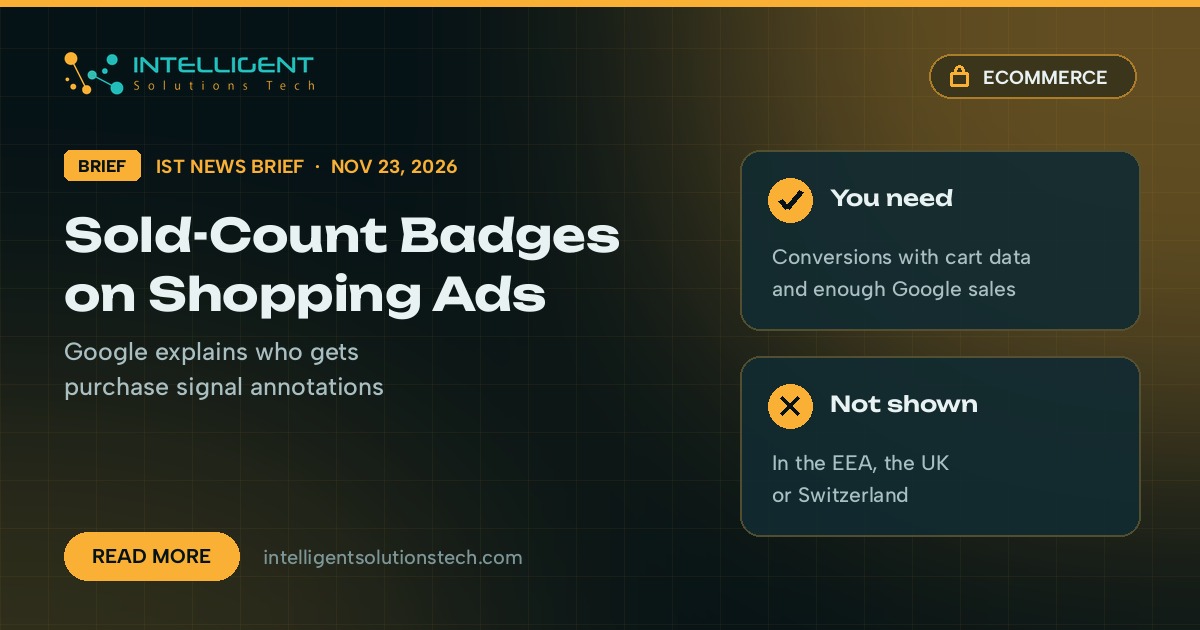
Google has published a new Google Ads help document on purchase signal annotations, the small badges on Shopping ads that read something like “100+ sold last 30 days.” Search Engine Roundtable spotted the document on November 23, 2026. The label had already shown up in live ads, but this is the first time Google has explained who qualifies and where it runs, in its purchase signal annotations help page.
What’s new
Google says it can show the annotation automatically on eligible Shopping ads to point out high-demand items. There is nothing to switch on and no extra budget. The badge rounds the number, so an item with 1,500 Google-attributed sales in 30 days would show “1K+ sold last 30d.”
- You have to report item-level sales with conversions with cart data.
- The count only includes Google-attributed conversions, so sales from your own site traffic, email or marketplaces don’t add to it.
- Each product has to pass a minimum sales volume, which Google says is there for privacy.
- It runs worldwide on mobile and desktop search, except in the EEA, the UK and Switzerland.
Who it affects
This is for online stores running Shopping or Performance Max campaigns in the US, Canada, Australia and most other markets. Stores in the UK and the EU won’t see the badge on ads served there, even if their tracking is perfect.
Plenty of stores send purchase conversions to Google Ads without the cart data behind them. That gap now decides whether your best sellers can carry a social-proof badge in the busiest shopping week of the year.
Our take
We’d check two things this week. First, open your Google Ads conversion settings and see whether your purchase tag passes cart data, meaning the item IDs, quantities and prices for each order, with IDs that match your Merchant Center feed. Second, if it doesn’t, schedule the fix for after the Black Friday and Cyber Monday rush rather than editing tracking mid-sale. Don’t expect the badge on slow sellers, because the volume threshold rules them out.
Our PPC management team sets up cart data and Shopping tracking for stores, and our ecommerce SEO work covers the organic side. For more on this season’s ad changes, see our post on Demand Gen seasonality adjustments.