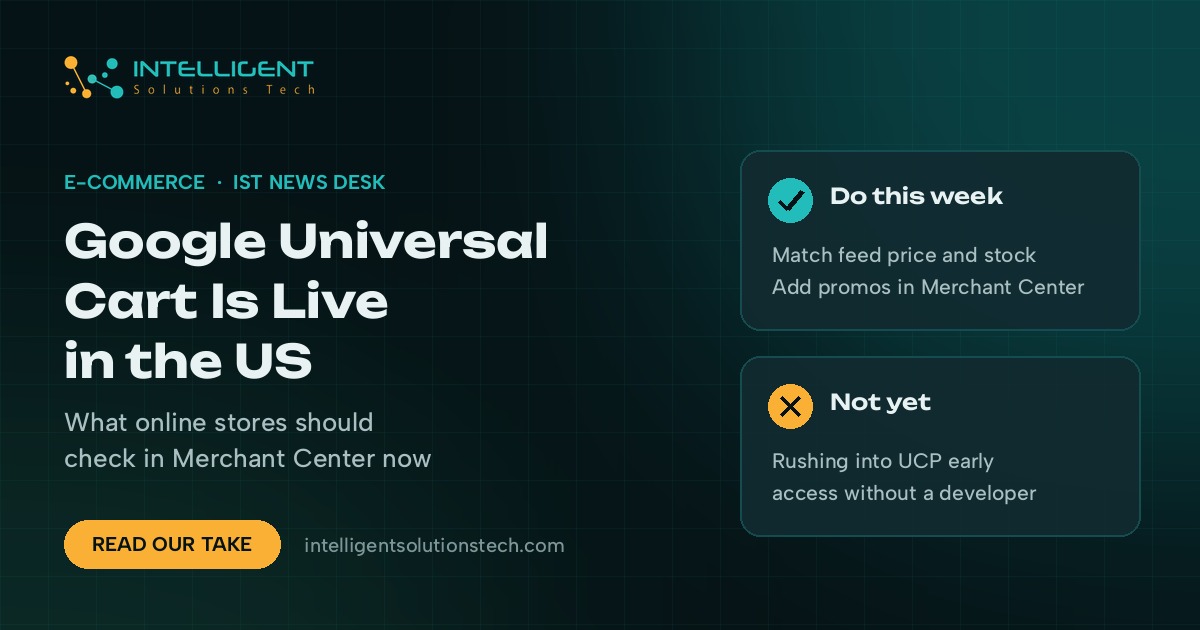
Google Universal Cart started rolling out in the US on October 15, 2026. According to Google’s announcement on its Keyword blog, it’s one cart inside AI Mode in Search and the Gemini app where shoppers can save products from different retailers, get alerts when prices drop or items come back in stock, and pay with Google Pay at many stores without leaving Google.
Our view: this is the first Google shopping change in a while that reaches into checkout itself, and the stores that win from it will be the ones with clean, current product data. Most small stores won’t get the Google Pay checkout on day one. They can still end up in a shopper’s cart, and the work that gets them there is the same feed work that already pays off in Shopping results.
If you only sell to customers outside the US, nothing changes for you this week. Google’s Merchant Center documentation says Australia and Canada are next, early next year, so it’s worth getting the groundwork done now.
What changed
Google described Universal Cart as a shopping hub that follows the shopper across Search and the Gemini app. Here’s what the announcement and Google’s merchant docs actually say:
- One cart, many stores. Shoppers can save items from different retailers in one place and pick up later where they left off.
- Price and stock alerts. Google said the cart draws on its Shopping Graph, which it puts at more than 60 billion product listings, to notify shoppers about price drops and restocks.
- Payment help. The cart is built on Google Wallet. It can suggest which card to use based on card perks and surface relevant promo codes.
- Two ways to check out. For many stores, shoppers can pay with Google Pay in a few taps. Otherwise they can send the items to the merchant’s own cart and finish on the store’s site. Google named Nike, Sephora, Target, Ulta Beauty, Walmart, Wayfair and many Shopify merchants as checkout partners.
- The merchant stays the seller. Google said retailers remain the seller of record and handle order confirmations and customer support.
Under the hood it runs on Google’s Universal Commerce Protocol (UCP). Google’s Merchant Center docs say the UCP hub is rolling out gradually in the US to select merchants through an early access program. Merchants fill in an interest form, build the technical side, test in sandbox and production, then declare they’re ready to go live. Only products carrying the checkout eligibility attribute get the Buy now button. Search Engine Land’s coverage made the same point from the shopper side: not every retailer or product gets the same checkout.
What it means for your business
The cart runs on your product data. Price-drop and back-in-stock alerts can only be as accurate as the price and availability Google holds for you. If your feed lags behind your site, a shopper who saved your product either gets a wrong alert or no alert, and the sale goes to the store whose data was right.
Comparison gets easier for shoppers. Items from several stores sit side by side in one cart, with promo codes and card perks next to them. Stores that compete only on price will feel that. Stores with clear shipping costs, fair returns and real promotions in their feed have something to show.
Shopify stores are in a good spot, but don’t assume you’re included. Google said many Shopify merchants are part of checkout, and its docs tell merchants on third-party platforms to ask their platform about UCP plans. That’s the right first question for most small stores.
We wouldn’t rush into the UCP early access program unless you have a developer and a decent-sized US catalog. It’s a technical build with testing steps, and Google is limiting it to select merchants for now. For everyone else, the useful work this week is in Merchant Center, and it helps whether or not you ever get the Buy now button.
It’s too early to say how much traffic Universal Cart will move. We’ll watch how orders that start in Google’s cart show up in client stores and analytics before we tell anyone to change their pricing or their ad budget.
What we’d do this week
- Fix Merchant Center first. Clear disapproved and limited products, starting with your best sellers.
- Match feed to site. Spot-check 20 products and confirm the price and stock in your feed match the product page. Check how often your feed updates and move to daily or faster if you can.
- Submit your promotions. If you run sales or discount codes, add them in Merchant Center as well as on your site, so Google has them when it shows deals in the cart.
- Ask your platform. On Shopify or another platform, ask support whether your store is part of the Google checkout rollout and what you need to switch on.
- Decide on early access. If you have developer time and a meaningful US catalog, read Google’s UCP guides and decide whether to fill in the interest form. If not, wait for your platform.
This sits right next to the AI Mode changes Google made the same day, which we covered in our AI Mode links update post. If you want help with your product feed or store setup, see our ecommerce development and ecommerce SEO services, or start with a free audit of your store.