Plenty of business owners in the US, UK and Australia have thought about sending development, marketing or back-office work offshore. Fewer have a clear plan for how to do it without losing control of quality, data or deadlines.
This guide covers outsourcing IT to Pakistan from the buyer’s side: which work travels well, how the time zones line up, what to put in writing and how to run the first few months. We’re based in Lahore and have worked with overseas clients since 2018, so this is the advice we’d give a friend.
Why businesses look at Pakistan
Pakistan has a large pool of software developers, designers, marketers and support staff, concentrated in Lahore, Karachi and Islamabad. English is widely used in business and in universities, so written communication in English is normal for most professional teams.
The other draw is the working day. Pakistan’s time sits ahead of the UK and North America and behind Australia, which allows either overlap hours or overnight turnaround depending on how you set things up. Cost is part of the picture too, but buyers who choose on hourly rate alone are usually the ones who end up disappointed.
Work that travels well
The best candidates have clear inputs, clear outputs and can be checked without someone standing in the room. These are the categories we see work reliably:
- Web and app development: new builds, maintenance, bug fixes, speed work and migrations.
- Automation and API connections: n8n, Make or Zapier workflows, CRM setup, API connections between your tools.
- SEO and content: technical fixes, local SEO tasks, citation building, blog and service page writing.
- Social media: content calendars, post writing, design and scheduling.
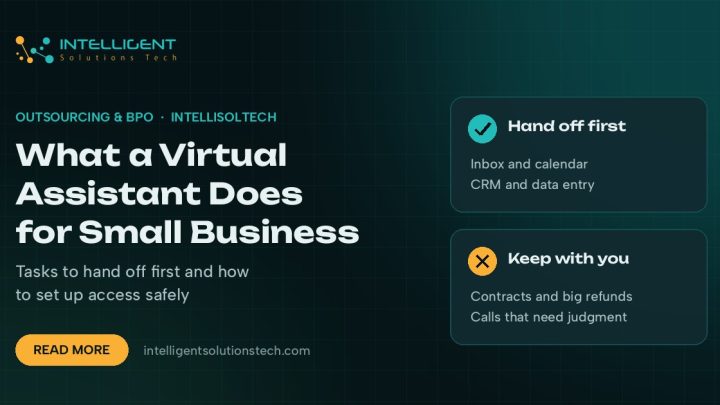
- Non-voice back office: email and chat support, data entry, order processing, document handling, virtual assistance.
- Business development support: lead research, list building and email or LinkedIn outreach.
Work that depends on in-person visits, deep regulated sign-off or constant real-time phone contact is a harder fit. Keep those in-house or redesign the process first. Our non-voice BPO service focuses on the written, async side of operations for this reason.
How the time zones actually work
Pakistan Standard Time is UTC+5 all year, with no daylight saving. Your offset shifts when your own clocks change, so check twice a year.
| Your location | Lahore is… | Practical overlap |
|---|---|---|
| New York / Toronto | 9 hours ahead (US daylight time), 10 hours ahead (standard time) | Your early morning is their evening; overnight turnaround suits most work |
| Los Angeles / Vancouver | 12 to 13 hours ahead | Little live overlap; plan async handoffs and one weekly call |
| London | 4 hours ahead (BST), 5 hours ahead (GMT) | Your morning overlaps their afternoon; easy for daily check-ins |
| Sydney / Melbourne | 5 hours behind (AEST), 6 hours behind (AEDT) | Their morning is your afternoon; a few shared hours each day |
Many Pakistani teams that serve North American clients shift their hours later in the day to create overlap. Ask about this upfront. For US buyers, the overnight model often works best: you send requests by end of day and review finished work the next morning.
What to put in writing
A clear contract protects both sides and prevents most disputes before they start. At minimum, it should cover:
- Scope: the specific deliverables, monthly volumes or hours, and what counts as out of scope.
- Price and payment terms: fixed monthly fee or per-project, invoice schedule and currency.
- Intellectual property: all code, designs and content you pay for are assigned to you on payment.
- Confidentiality: an NDA covering your business information and your customers’ data.
- Data protection: a data processing agreement if you’re subject to GDPR, UK GDPR or Australia’s Privacy Act.
- Access and handover: how credentials are shared and revoked, and what you receive if the relationship ends.
- Reporting: what you’ll see and how often.
Keep ownership of every account in your own name: domain, hosting, code repository, Google Business Profile, ad accounts and social pages. Grant your partner user access. Never let a vendor hold the only login.
Protecting your data and systems
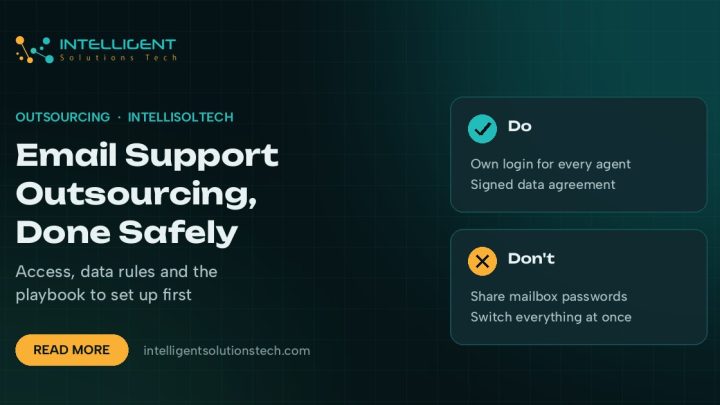
- Use a password manager like 1Password or Bitwarden to share credentials, never plain email or chat.
- Give each person their own login with the lowest permissions that let them do the job.
- Turn on two-factor authentication on every shared system.
- Keep customer data inside your own tools (CRM, help desk, cloud storage) instead of copying it to the vendor’s systems.
- Review and remove access when a project ends or a team member changes.
- Ask how the partner handles devices, backups and staff offboarding on their side.
Payments, communication and the first 90 days
Paying a Pakistani company
International bank transfers, Payoneer and Wise are the common routes. Agree on the currency (most overseas clients pay in USD, GBP, AUD or EUR) and who covers transfer fees. Fixed monthly fees are easier to budget for than open-ended hourly billing.
Setting up communication
Pick one place for requests, such as Asana, Trello, ClickUp or a shared Slack channel, and one place for files. Use WhatsApp or Slack for quick questions and short Loom videos for anything visual. Write requests the way you’d brief a new hire: goal, examples, deadline and what done looks like.
Running the first 90 days
- Days 1 to 30: start with one contained piece of work. Review everything closely and give detailed feedback.
- Days 31 to 60: add a second workstream once the first is running without heavy correction. Write down the standards you’ve agreed on.
- Days 61 to 90: move to a regular reporting rhythm and decide what else to hand over based on actual results.
This is close to how our own projects are structured on the how we work page: free audit, written proposal with a fixed monthly scope, staged builds that you review before anything goes live, then ongoing work with a report every two weeks.
Red flags when choosing a partner
- They promise guaranteed rankings, guaranteed leads or results they can’t control.
- They won’t put scope, IP ownership and confidentiality in writing.
- They want to own your domain, hosting or ad accounts.
- They can’t explain who does the work or how it gets reviewed.
- Every answer is yes, with no questions back about your business.
You can read more about working with us from Lahore on our Pakistan page, or see the full list of non-voice BPO and digital services we provide to clients abroad.
The easiest way to test fit is a free audit of your website. Verify your email, we’ll run it and send a PDF, and you’ll see how we communicate before committing to anything.
Frequently asked questions
Is it safe to outsource IT work to Pakistan?
It can be, with the same controls you’d use for any vendor: a written contract with IP and confidentiality terms, accounts kept in your name, individual logins with limited permissions and a password manager for sharing credentials.
What time zone is Pakistan in?
Pakistan Standard Time is UTC+5 and doesn’t observe daylight saving. Lahore is four to five hours ahead of London, nine to ten hours ahead of New York and five to six hours behind Sydney, depending on the season.
How do I pay a company in Pakistan?
Most overseas clients pay by international bank transfer, Payoneer or Wise, in USD, GBP, AUD or EUR. Agree on currency, invoice dates and who covers transfer fees in the contract.
What kind of work is best to outsource first?
Start with contained, well-defined work that’s easy to review, such as website maintenance, a set of automation workflows, content writing or email support. Expand once quality and communication are proven.