Anthropic released Claude Fable 5.2 and Claude Mythos 5.2 on November 9. According to Anthropic’s launch page, Fable 5.2 is available now to all users, on Anthropic’s own platform and through Amazon Web Services, Google Cloud and Microsoft Azure. Mythos 5.2 stays limited to vetted organizations.
For a small business, the news that matters is price and speed. Anthropic lists Fable 5.2 at $8 per million input tokens and $40 per million output tokens. The Next Web reports that Fable 5.1 cost $10 and $50, so that’s a 20% cut on the top public Claude model, plus answers Anthropic says arrive up to 30% faster.
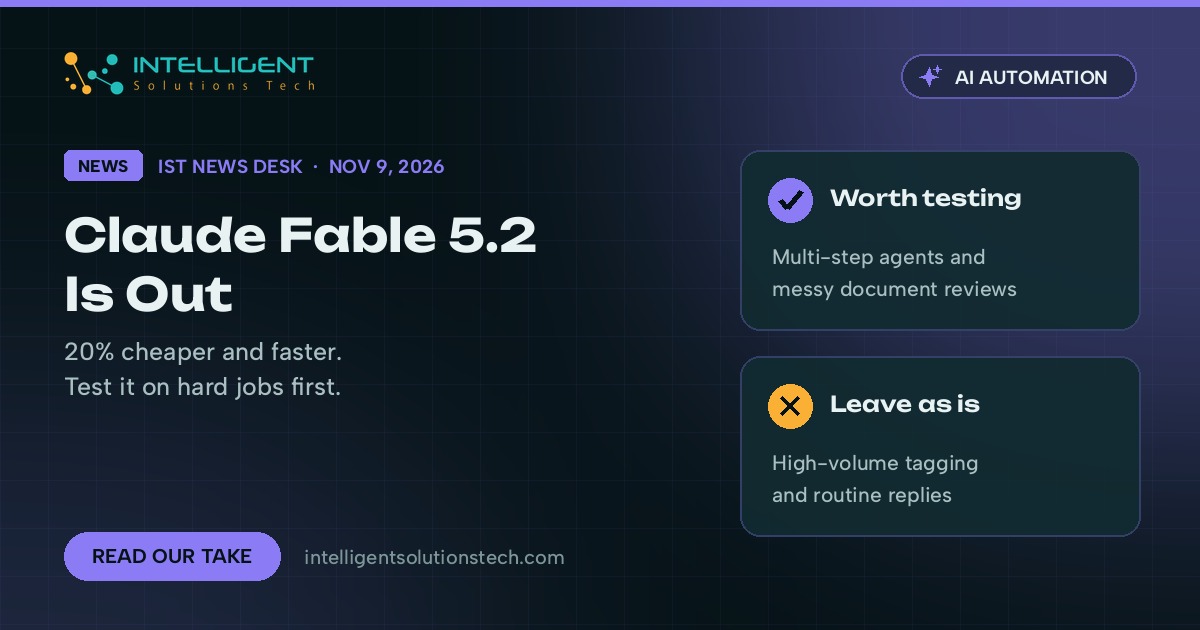
Our view: this is a good reason to re-test the jobs where you settled for a cheaper model because the top one cost too much. It isn’t a reason to move every automation you run onto the most expensive model Anthropic sells.
What changed
Anthropic describes Fable 5.2 and Mythos 5.2 as the same underlying model. Fable carries extra safeguards around cybersecurity and biology so it can be offered to everyone. Mythos has fewer of those safeguards, and access runs through Anthropic’s Cyber Verification and Life Sciences Verification programs. Claude Enterprise customers can use Claude Security, which Anthropic says runs on Mythos 5.2.
The changes Anthropic lists for Fable 5.2:
- Lower price. $8 input and $40 output per million tokens, down from $10 and $50 on Fable 5.1, per The Next Web.
- Faster output. Up to 30% faster than the 5.1 versions, according to Anthropic.
- A paid fast mode. An optional mode Anthropic says generates tokens up to 2.5 times faster, priced at $16 input and $80 output. It’s offered in Claude Code, the Claude Platform, Google Cloud and Microsoft Foundry.
- Fewer blocked requests. Anthropic reports about 55% fewer blocks than Fable 5.1 in its testing. Requests its classifiers still flag as high-risk cyber or biology work get answered by older models (Opus 4.8 and Opus 5) instead.
- Subscription access. Fable is included for up to half of weekly usage limits on Pro plans and standard Team seats, and eligible paid subscribers get extra Fable usage during the launch.
Anthropic also published benchmark scores that put Fable 5.2 ahead of Opus 5.5 on coding, computer use and research tests. Those are vendor-run numbers on vendor-chosen tests, so we would test on your own work before trusting them.
What it means for your business
Most small business AI work doesn’t need the top model. A support bot answering order questions, a flow that tags inbound email, or a step that pulls fields from invoices runs fine on Haiku or Sonnet, and those models cost a fraction of Fable. That hasn’t changed. Our Claude Haiku 5.5 write-up covers the high-volume side.
Where Fable 5.2 earns its price is the hard, low-volume work: long multi-step agent tasks, messy document reviews, coding jobs on a real website or CRM, and anything where a wrong answer costs more than the tokens. A 20% price cut and faster replies make those jobs cheaper to run and less painful to wait on. If you tried Fable 5.1 for an agent and found it slow or too costly, it’s worth a second look.
The fallback behavior is the other thing to know. If your work touches security, such as a script that reviews server logs or checks plugin versions, some requests may be answered by an older model without you noticing. Check your outputs on those jobs, and read the response metadata if your tool shows which model replied.
On data handling, Anthropic says eligible customers can use the models with zero data retention, while other customers have 30-day retention for safety monitoring. If you handle client records or health and financial data, confirm which applies to your account before you send that data through.
What we’d do this week
- List the AI jobs where quality or reliability is the problem today, not volume. Those are the only candidates for Fable 5.2.
- Run 20 to 50 real past tasks from one of those jobs through Fable 5.2 next to your current model, and have a person grade the outputs side by side.
- Compare full cost per finished task from your usage logs. A pricier model that gets it right the first time can still cost less than a cheaper one that needs retries.
- Skip fast mode unless a person is waiting on the answer in real time. At double the price, it rarely pays for background automations.
- Leave high-volume, simple jobs on Haiku or Sonnet. Don’t upgrade them because a new model shipped.
- If you’re on a Pro or Team plan, try Fable on one real piece of work this week while the launch usage boost lasts, and note where it helped.
If you’d like help picking which of your workflows to test, our Claude AI integration team does exactly this kind of model check, and our AI agents service covers the multi-step jobs where Fable fits best. The automation ROI calculator gives a quick read on which jobs are worth the effort, or you can start with a free audit.