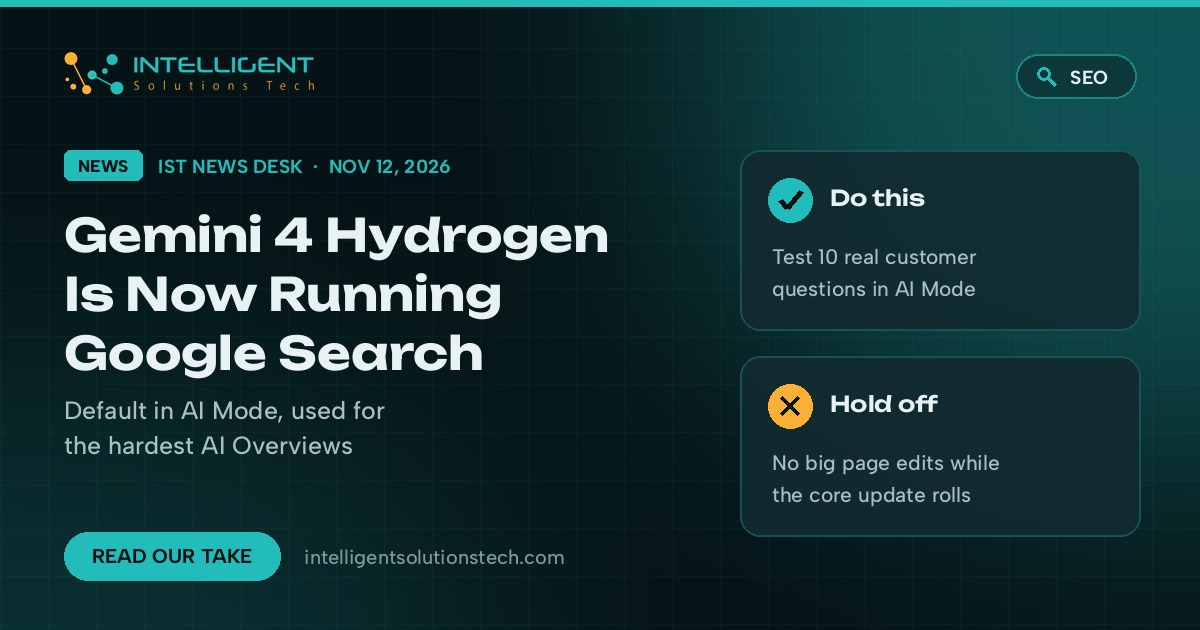
Google put Gemini 4 Hydrogen into Google Search on November 12, 2026, and called it the biggest model upgrade to Search yet. Robby Stein, Google’s VP of Product for Search, wrote on the Google blog that Hydrogen is now live globally for all users. In a post on X, reported by Search Engine Roundtable, he added that it’s the new default model in AI Mode and handles the hardest questions in AI Overviews.
For business owners, this is a change to how Google’s AI answers are written and which sites they link to. It isn’t a ranking update in the classic sense, and Google hasn’t said it touches the ten blue links. It did land in the middle of the November 2026 core update, though, which makes any traffic change this week harder to read.
Our view is simple. Don’t rewrite pages because of Hydrogen this week. Use the next two weeks to watch how AI Mode answers your customers’ real questions, and fix the gaps once the core update settles.
What changed
Google listed four improvements in its announcement:
- Better reading of intent. Search should handle long, multi-part questions, typos and very specific requests, with closer instruction following and tool calling.
- Wider query fan-out and more links. Google says Hydrogen runs simultaneous searches across the subtopics of a question and links to a broader range of sites, including ones people may not have found before.
- More visual answers. Expect more images, structured responses, comparison tables and small custom tools inside AI answers.
- Richer language support. Google says answers improve in every language AI Mode supports.
The model itself comes from Google DeepMind. Koray Kavukcuoglu, Google’s Chief AI Architect, wrote that Hydrogen replaces Gemini 3.8 Flash and is rolling out across Google AI Studio, the Gemini API, Gemini for business, the Gemini app and Search. Ars Technica reported that API pricing stays the same as 3.8 Flash, at $1.50 per million input tokens and $7.50 per million output tokens, and that free Gemini app users don’t get it yet.
What it means for your business
The fan-out change is the part to watch. When someone asks a three-part question, such as which roofer near them handles insurance claims, works weekends and offers financing, Google now splits it into smaller searches and pulls answers for each part. A page that answers one of those parts clearly has a better shot at being linked than a page that answers none of them well.
That rewards specific pages. Service pages that say what you do, where you do it, what affects the price and how long the job takes give the model something to quote. Pages built around vague claims give it nothing.
The visual side matters too. If AI Mode starts answering more questions with comparison tables, the sites that already publish clean tables and plain lists are easier to pull from. Google hasn’t published guidance saying tables help, so treat this as a sensible bet.
Then there’s the timing. Google’s Search Status Dashboard shows the November 2026 core update started on November 10 and can take up to two weeks. Hydrogen arrived two days later. If your traffic moves this week, you won’t be able to tell which change caused it by looking at one chart. Search Engine Roundtable also reported that Google confirmed a data bug in the Search Console Generative AI performance report from November 9 to 11 that undercounted impressions, so a dip on those days isn’t real.
What we’d do this week
- Leave your pages alone for now. Big edits during a core update make it harder to see what actually happened. Note November 10 and November 12 in your analytics instead.
- Ask AI Mode ten real customer questions. Use the long, messy questions people send you by email or WhatsApp. Write down whether your site is linked and which sites are.
- List the sub-questions you don’t answer. Price factors, service areas, timelines, materials, warranties. These become your edit list for after the rollout.
- Check your structured data and key facts. Business name, address, hours and services should match across your site and listings so the model doesn’t mix you up with someone else.
- Compare after the update ends. Wait for Google to confirm the core update is complete, then compare two full weeks of Search Console data by page and query.
We covered the rollout itself in our post on Google’s November 2026 core update, and the paid-tier model in Gemini 4 Carbon’s arrival in AI Mode. You can read Google’s announcement on the Google blog.
If you’d like help working out where AI answers mention you and where they don’t, our SEO team can start with a free audit of your site and the questions your buyers ask.