For twenty years, Google owned the toolkit every business used to show up online. Search Console told you how you ranked. Analytics told you who arrived. Merchant Center put your products in front of shoppers, and Business Profile put you on the map. If you wanted to be found, you filled in Google’s forms.
That monopoly on the toolkit is breaking. In 2026, AI platforms started building their own versions of every one of those tools: AI search consoles that report citations, merchant programs that take product feeds, and business hubs where a company can claim its presence inside a chatbot. Each one is a new account to set up, a new feed to maintain and a new report to read.
Our view: this is the biggest change in how SEO agencies work since mobile. Google isn’t disappearing, and we’ll show the numbers. But the single-console era is over, and the agencies that learn to run five consoles instead of one will win the next decade of clients.
The Google toolkit is being rebuilt, platform by platform
Here’s how the pieces line up today. Some of this is live, some is in preview, and one piece is reported but not confirmed by the company, which we flag below.
| What a business needs | The Google tool | The AI platform version |
|---|---|---|
| See how you appear in search | Search Console | Bing AI Performance report, Google’s generative AI report, a reported ChatGPT business dashboard |
| Get products in front of shoppers | Merchant Center | OpenAI merchant program, Perplexity merchant program |
| Claim and manage your business | Business Profile | Reported “claim your business” in ChatGPT, Gemini business hub |
| Measure the traffic | Google Analytics | Perplexity merchant dashboard, Microsoft Clarity agent analytics, AI referrals in GA4 |
AI search consoles
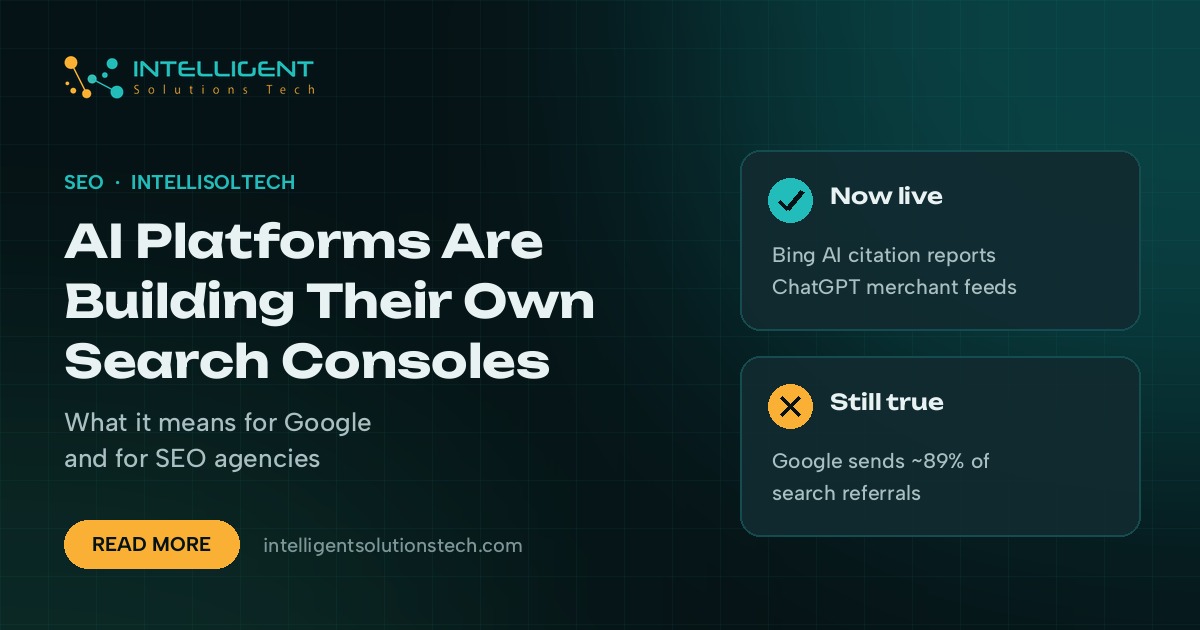
Microsoft moved first. Bing Webmaster Tools added an AI Performance report in public preview in February 2026, showing when Copilot and Bing’s AI answers cite your pages and which grounding queries triggered the citation. In June, Microsoft added intent labels, topic clusters, a citation share metric and period comparisons. For the first time, a site owner could see the questions an AI answered with their content.
Google followed. According to Search Engine Roundtable, Search Console’s generative AI performance report reached every site on August 31, 2026. It shows impressions of your pages in AI Overviews, AI Mode and Discover, by page, country and device. It doesn’t show clicks or queries yet, which tells you how early this all is.
Then there’s DeepSeek. GIGAZINE reports that on October 17, 2026, DeepSeek opened Search and Fetch APIs powered by its own in-house search engine, priced at $0.75 per 1,000 successful requests. That’s a new search index nobody in the West was optimizing for a year ago. It has no webmaster console, no sitemap submission and no performance report. Its crawler, DeepSeekBot, says it respects robots.txt, and the only way we know of to check whether your site is in the index is to pay for API queries with the site: operator.
AI merchant centers
OpenAI runs a merchant program at chatgpt.com/merchants. Approved merchants send a product feed at least once a day, with nine required fields per product, from item ID and title to price and availability, and US Shopify stores can connect through an Agentic sales channel instead. In March 2026 OpenAI shifted ChatGPT shopping toward discovery and let merchants send buyers to their own checkout.
Perplexity’s merchant program is free for brands that sell and ship in the US, and it comes with a dashboard of search and shopping trends, plus tagged links so you can see which listings drive visits and sales. Google, for its part, now lets shoppers check out inside AI Mode and Gemini in more countries. The product feed you built for Google is now one of three or four you need.
AI business listings
This is the piece to watch. On November 6, Search Engine Roundtable reported that OpenAI is building a business hub where companies can claim their business in ChatGPT, keep product and business details current, and see mention counts, impressions and link clicks in a daily chart. It was spotted in a screenshot shared on LinkedIn, it appears limited to verified businesses such as connected Shopify stores, and OpenAI hasn’t announced it. Treat it as reported, not launched.
If it ships, it’s a Business Profile for ChatGPT. Google is building the same thing from the other side with its Gemini business hub, and Microsoft Clarity just added agent tracking and brand agents for local businesses. Every major assistant now wants a direct relationship with the businesses it recommends.
Is this the end of Google?
The case for it goes like this. Google’s power was never just the search box. It was being the one place every business had to register, verify and feed. If ChatGPT, Perplexity, Copilot and DeepSeek each run their own index, their own merchant feed and their own business listings, Google stops being the gate and becomes one door among several. Add AI agents that compare, book and buy for the customer, and the ten blue links start to look like a fax machine.
Now the numbers. Cloudflare Radar data analyzed by TechnologyChecker shows Google sent 89.04% of search referrals to sites on Cloudflare’s network in Q3 2026, up from 81.10% a year earlier. ChatGPT sent 0.64%. By that measure, Google sends roughly 90 to 200 times the traffic of any single chatbot.
So our honest read: Google isn’t dying this year, and anyone telling clients to stop doing Google SEO is wrong. What is dying is conventional search, the page of ten links you click through one by one. And Google is the company killing it fastest, with AI Mode booking home service pros and checkout inside answers. For a business, the real question is whether it shows up correctly in every assistant its customers use, Google’s included.
Why this is the next big thing for SEO agencies
Every new console creates work a business owner won’t do alone. Someone has to open the accounts, verify the business, build and maintain the feeds, keep the facts identical across platforms, decide which AI crawlers to allow, and turn five different reports into one answer the owner understands. That’s an agency job, and a recurring one.
It also shifts what clients pay for. Rankings were the old deliverable. The new one is presence: is the business cited, is its product data right, does each assistant describe it accurately, and how much traffic and revenue came from those answers. Agencies that package that as a monthly service, which we call AI visibility management, will have a story to sell when every competitor is still sending the same rank report.
- Platform setup: Bing Webmaster Tools, Search Console, OpenAI and Perplexity merchant programs, and each business hub as it opens.
- Feed management: one clean product catalog, shipped to every platform on its own schedule and format.
- Entity consistency: the same name, address, hours, services and prices everywhere an AI might read them.
- Crawler policy: a deliberate robots.txt decision for each AI crawler, so nobody blocks the assistants their customers use by accident.
- Reporting: citations, AI impressions and AI referral traffic in one monthly view.
What we’d do for a client this month
- Open the consoles that exist today. Verify the site in Bing Webmaster Tools and check its AI Performance report, then check the generative AI report in Search Console. These are free and live now.
- Check which AI crawlers you allow. Read your robots.txt for DeepSeekBot, OAI-SearchBot, PerplexityBot and Google-Extended. Block only what you’ve decided to block.
- Get product feeds ready. If you sell online in the US, apply to the OpenAI and Perplexity merchant programs and make sure your Merchant Center feed is clean, since the same data feeds all three.
- Fix your facts at the source. Your website, Business Profile and main directories should agree on every detail. AI answers pull from all of them.
- Track AI traffic separately. Set up an AI assistants channel in GA4 so referrals from ChatGPT, Perplexity, Copilot, Gemini and Claude show as their own line.
- Ask the assistants about yourself. Once a month, ask the main assistants what they know about your business and note what’s wrong. That list becomes your to-do list.
We’re adding these checks to every SEO engagement and to our white-label SEO service for agencies. If you want to know where your business stands across Google and the AI assistants, start with a free audit, or read our guide on getting cited in ChatGPT and AI Overviews.