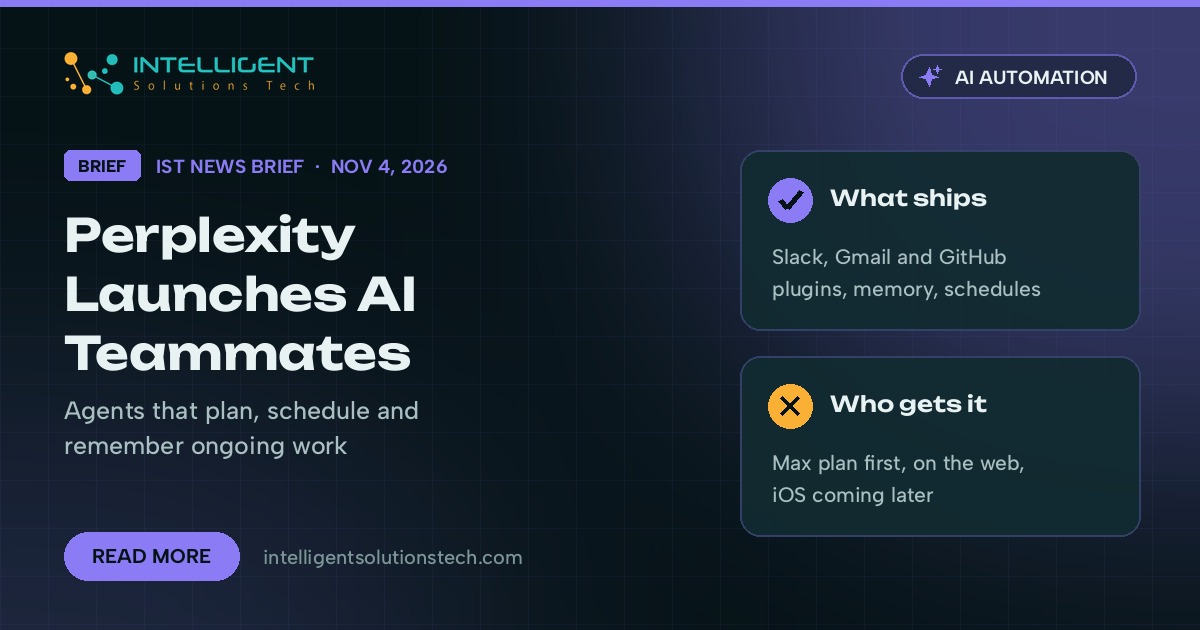
Perplexity announced Teammates on its blog on November 4, 2026. They are personal AI agents built for long-running work inside Perplexity Computer, the company’s agent workspace. A teammate can plan a project, watch for changes, run on a schedule and bring finished work back for review. Access starts on the web for Perplexity Max subscribers, with iOS coming later.
What’s new
- Ongoing ownership. Perplexity says a teammate plans the work, checks results along the way and returns completed tasks for approval, such as market research or investigating an issue.
- Schedules and monitoring. You set when a teammate acts, and it can run recurring jobs like a weekly pipeline review. Perplexity’s example is a sales teammate that spots a regular customer who stopped ordering.
- Memory. Teammates keep project goals, task history, shared files and your feedback between runs.
- Connectors. Slack, GitHub and Gmail plugins are named. You pick which GitHub repositories a teammate can see, and you can add a teammate to a Slack channel so colleagues can assign it work.
- Controls. Each teammate runs in its own environment, saved credentials are encrypted, and teammates inherit the permissions already set in Computer. You can take over or redirect one mid-task.
Who it affects
Right now, only teams on the Max plan can use it, and Perplexity says Free and Pro users can upgrade from their account settings. Perplexity also says access and features will expand in the coming weeks, so the current limits may change. It matters most to small teams that already live in Slack and Gmail and have repeat research or follow-up work nobody owns.
It also joins a crowded field. Google, Microsoft and OpenAI are all pushing agents that sit inside the tools a team already uses, so the real issue for most owners is how to hand work to software safely, whichever vendor they pick.
Our take
We’d treat Teammates as a pilot project for now. The useful part is the approval step: work comes back for review instead of going straight out. If you test it, start with one read-only job, like a weekly summary of open deals or a competitor check, and give it access to one Slack channel and nothing else. Write down what a person did before, so you can judge whether the agent saves real hours. For jobs that must run the same way every time, a plain automation is often cheaper and easier to audit, as we explain in AI agents vs automations.
Perplexity’s announcement is on its blog. If you want help scoping a first agent or automation, see our custom AI agents service or our AI workflow automation team.