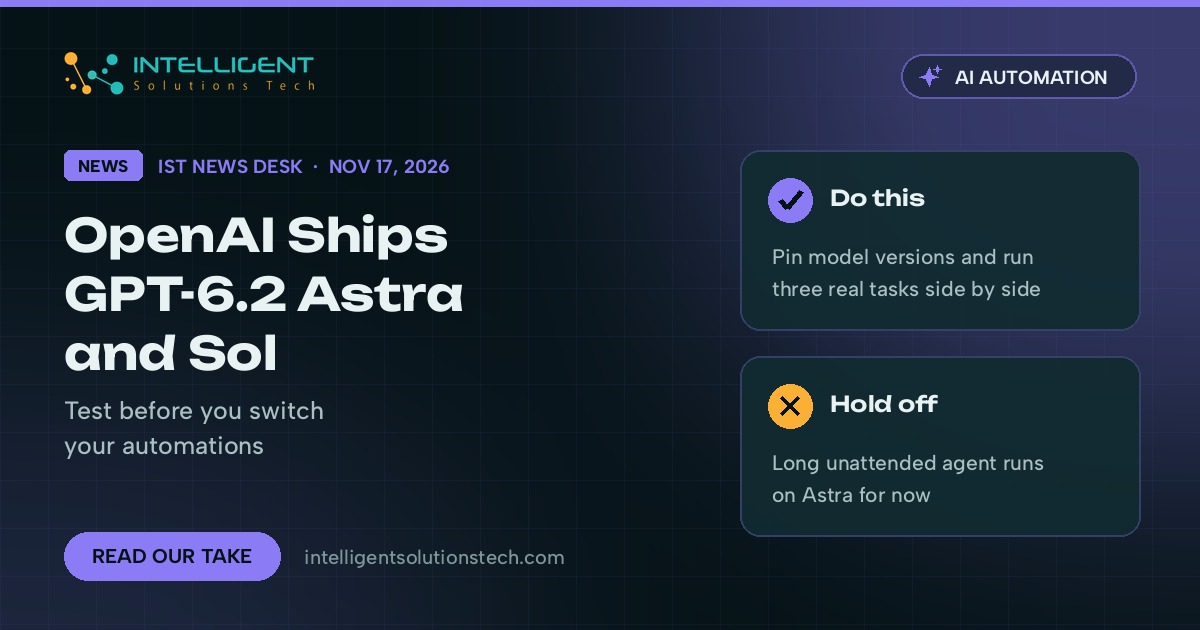
OpenAI released GPT-6.2 Astra and GPT-6.2 Sol on November 17, 2026. In a post on X, OpenAI said both models are available starting that day in ChatGPT Work and Codex for Plus, Pro, Enterprise and Edu users, and developers can call them through the API. Astra is the frontier model for heavier professional work. Sol is the cheaper everyday model.
Our view: GPT-6.2 Sol is the model most small businesses should care about, because it’s the one that will quietly sit behind their automations at a sensible cost. Astra is worth a test on hard, one-off jobs. We wouldn’t rebuild any working workflow around either model this week, and the early reviews give good reasons to wait.
Below is what changed, what it means for a business that uses ChatGPT or runs AI inside its tools, and what we’d do between now and the end of the month.
What changed
OpenAI shipped two models at once. VentureBeat, reporting from OpenAI’s launch materials, says Astra is pitched at complex codebase changes, building working web apps and producing documents that follow company templates. Sol is pitched at routine coding, writing and multi-step workflows. Thurrott reports that OpenAI says both models finish demanding tasks with fewer output tokens, so paid users get more done inside the same usage limits.
The API pricing matters most for anyone running automations. According to VentureBeat, gpt-6.2-astra costs $8 per million input tokens and $40 per million output tokens, 20% below GPT-6 Astra. Sol stays at $2 input and $10 output, the same as GPT-6.1 Sol. Prompts longer than 272K tokens cost more, and batch jobs run at half the standard rate.
- Who gets it in ChatGPT: Plus, Pro, Enterprise and Edu users, inside ChatGPT Work and Codex.
- API names: gpt-6.2-astra and gpt-6.2-sol.
- Vendor claims: OpenAI says Astra beat GPT-6 Astra on all nine benchmarks in its launch set, and Sol beat GPT-6.1 Sol on eight of nine.
The reception has been mixed. VentureBeat collected reviews from heavy users who found Astra stopped early on long builds, was hard to steer and wrote answers so short they left out needed context. Independent testers at Artificial Analysis scored Astra flat and Sol slightly lower on their coding-agent index. Other testers praised Astra’s code review and its computer-use skills.
What it means for your business
If your team uses ChatGPT by hand for emails, proposals and summaries, you’ll see the new models in the picker and not much else. Shorter answers may feel like an upgrade or a step back depending on the task. Give it a week of normal work before you decide.
If you run automations that call OpenAI’s API, such as lead triage, inbox sorting, invoice reading or a website chatbot, the picture is different. A model swap can change tone, length and formatting overnight, and a step that parses the answer can break without any visible error. Shorter outputs are cheaper, which is good, until a summary drops the one detail your sales team needed.
Astra’s 20% price cut makes it more reasonable for tasks where quality really pays: drafting a long proposal from a template, reviewing a site’s code before a launch, or turning a messy spreadsheet into a clean report. For high-volume, repetitive steps, Sol at the same price as before is still the sensible default, and the batch rate halves that again for jobs that can wait.
The mixed reviews are the part we’d take seriously. Several testers said Astra handled long, unattended work poorly. That’s exactly the shape of an AI agent left running overnight, so agent-style workflows deserve the most caution.
What we’d do this week
- Pin your model versions. If any automation calls a general model alias, switch it to a named model you’ve already tested, so nothing changes under you.
- Pick three real tasks and run them side by side. Use last week’s actual emails, tickets or documents. Compare your current model with GPT-6.2 Sol on accuracy, length and whether the output still fits the next step.
- Test Astra only on hard, supervised jobs. A proposal draft or a code review where a person reads every line is a fair test. An unattended agent is not.
- Check the cost math. Move jobs that can wait a few hours to batch processing and see what it saves.
- Write down what you decide. Note which model runs which workflow and when you last tested it, so the next release takes an hour to assess instead of a week.
We’re running the same side-by-side tests on client workflows before we move anything to GPT-6.2. Our earlier take on GPT-6.1 Terra in business automation still covers how we pick a model for each job.
If you want a second pair of eyes on which model should run which step, our ChatGPT integration and AI agents teams can review your setup, and the automation ROI calculator helps size the savings. Start with a free audit. OpenAI’s announcement is on OpenAI’s X account.